
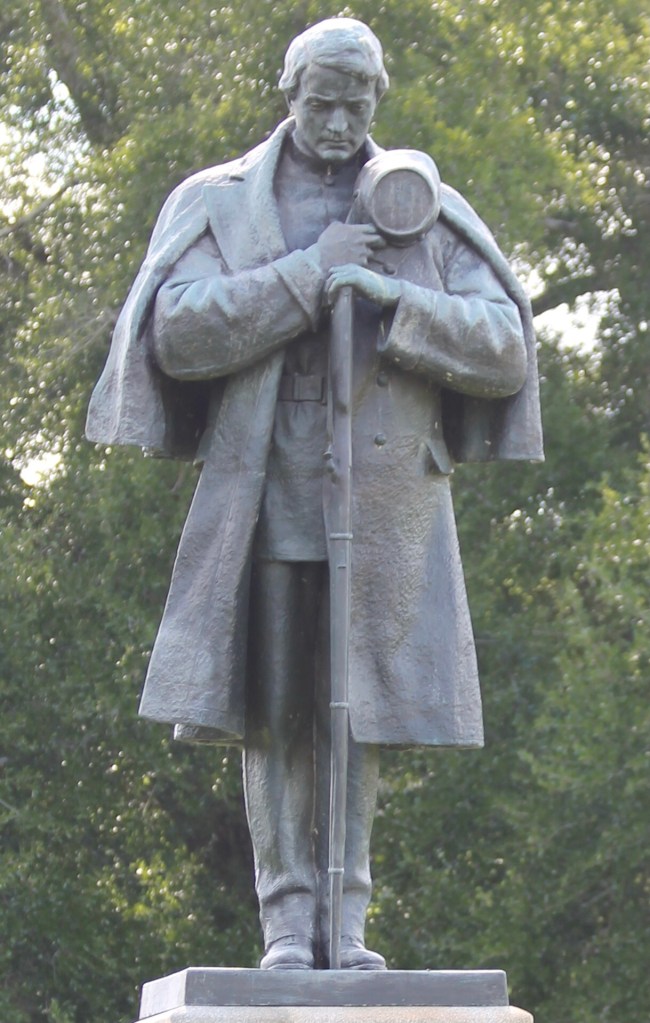
As I continue my journey with Thomas Merton, I am inspired and challenged by his words. In many parts of this nation and world, nonviolence and peacemaking aren’t popular topics.
After a wonderful and life-giving training event Denise and I offered to the Session (Council) at Carrollton Presbyterian Church, we sank into the couch after dinner. Looking for something to watch on Netflix, we discovered the movie “Big Miracle,” a story about the rescue of a whale family in Point Barrow, Alaska.
One of the powerful parts of this movie (based on a true story) was the cooperation between the Alaska Air National Guard, the Indigenous people of Point Barrow, an oil industry executive, members of Greenpeace, and the Soviet crew of an icebreaker. This cooperative effort resulted in the freeing of the mama and papa whales. Sadly the baby whale didn’t make it.
To put it into context… Reagan was at the end of his presidency and Gorbachev was the leader of the USSR… the time was a time of change as Glasnost encouraged mutual cooperation between the Soviet Republic and the United States. I am certain that if Merton had been alive, he would have celebrated this mutual cooperation for the greater good, in this case, saving the lives of two whales. I also believe that he would mourn the gigantic step backwards that has happened since the departure of Gorbachev and the ascent of Putin.
These words of his from his book, Blessed are the Meek: The Christian Roots of Nonviolence as found in Thomas Merton: Essential Writings, p. 130. — Instead of trying to use the adversary as leverage for one’s own effort to realize an ideal, nonviolence seeks only to enter into a dialogue with him in order to attain, together with him, the common good of man. Nonviolence must be realistic and concrete.
My continued prayer and the root of my own ministry is to walk with our congregation as we seek to be instruments of God’s peace. Where our mission is, in the words of the prophet Micah, Do justice, love kindness/mercy, and walk humbly with God and with one another.
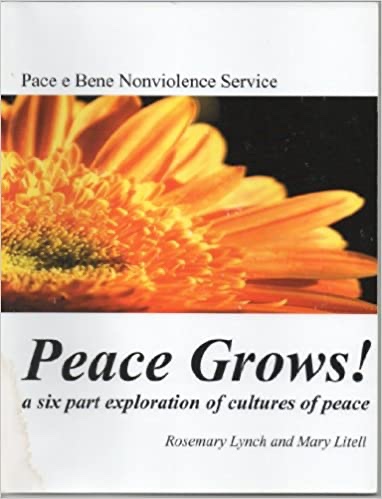
“The spirit of forgiveness is closely related to the sense of the Sacred. In order to hurt/destroy another being, it is necessary to blot out the sacredness. Forgiveness requires looking beneath the surface, seeing beyond the fear and anger, allowing compassion and understanding of our common woundedness to take over. This type of forgiveness happens on many levels, personal and societal.”—Rosemary Lynch and Mary Litell, Peace Grows!
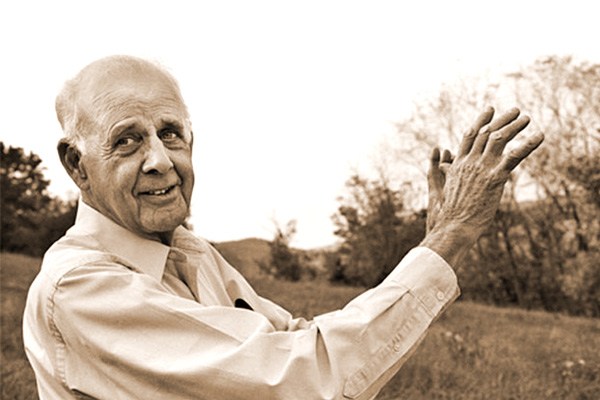
“It is the destruction of the world
in our own lives that drives us
half insane, and more than half.
To destroy that which we were given
in trust: how will we bear it?” —Wendell Berry

Sometimes Thomas Merton’s words are all I need to hear. This is one of those times!
Let me seek, then, the gift of silence and poverty, and solitude, where everything I touch is turned into prayer: where the sky is my prayer, the birds are my prayer, the wind in the trees is my prayer, for God is all in all. (Thoughts in Solitude, p. 194)
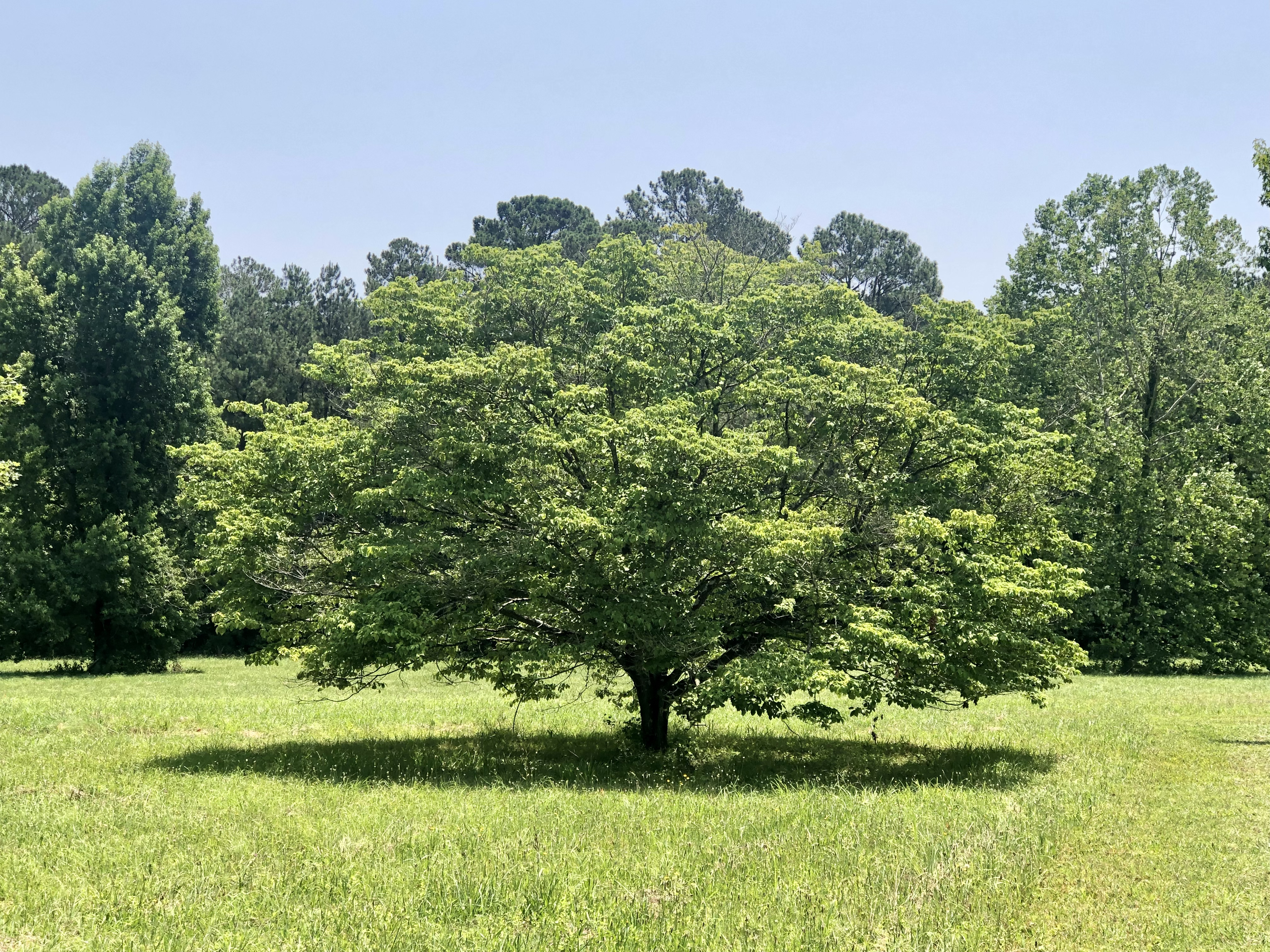

The last two outings that we have taken have been sort of a history trail. The history of these two places is dark and very sad. The tree stands on land where the Cherokee people once lived. From this place and others like it, an entire nation was removed from the land and forced to walk from Georgia to Oklahoma in what is called “The Trail of Tears.” The stories of brutality, naked greed on the part of white people along with the state & national governments are hard to read and listen to. But we must hear their stories and honor them.
The Red-winged Blackbird was in a tree close to a spring that had providentially arose following a storm and lightning strike on August 14th, 1864 at Andersonville. This gave some fresh water to the POW’s living inside of the prison stockade. One would need to read the stories and the history of this place in order to understand the horrific conditions that the Union prisoners endured. If you were only to look at the site as it is today, you would see a green and lush meadow with a meandering creek cutting through it. You wouldn’t see in your mind’s eye the overcrowded and muddy ground where the POW’s lived and died.
What struck me about both places was the fact that sites of great darkness slowly transformed into beautiful settings. That healing took many years to take hold and the work of healing is still far from over as our nation continues to grapple with the ugly and brutal parts of our history that many wish to gloss over or ignore. This type of healing must continue as we move forward in life’s journey.
Today has been a day of reflection for me. A guided meditation that we listened to this morning helped remind us of nature’s beauty and the holy encounters we have had in nature. Even with the beauty though, we were given the opportunity to acknowledge the pain that either the land felt or that we had experienced.
In his journal entry from December 2nd, 1948, Thomas Merton writes about his own reflections in nature. A thousand small high clouds went flying majestically like ice-floes, all golden and crimson and saffron, with clean blue and aquamarine behind them, and shades of orange and red and mauve down by the surface of the land where the hills are just visible in a pearl haze and the ground was steel-white with frost—every blade of grass as stiff as wire. (Entering the Silence, p. 248) This is such a vivid word-picture that Merton painted. Yet he also painted vividly horrifying pictures as he confronted the horrors of war and the nuclear arms race.
I need to remember each time that we go out for a hike or walk the stories we see in front of us and the beautiful pictures we paint with our cameras are only part of the story. We need to simply be present in the midst of creation with open hearts, minds, and spirits. Perhaps then, we will experience something bigger than us as the land speaks to us.
| Verse of the day Finally, all of you, have unity of spirit, sympathy, love for one another, a tender heart, and a humble mind. – 1 Peter 3:8 |
| Voice of the day Let us not forget: We are a pilgrim church, subject to misunderstanding, to persecution, but a church that walks serene, because it bears the force of love. – Óscar Romero, The Violence of Love (2004) |
| Prayer of the day By your Spirit, fashion our lives according to the example of your Son, and grant that we may show the power of your love to all among whom we live. – The Book of Common Prayer |

The sun has set and the Vesper Lights flicker and glow
For tonight’s Session meeting worship our focus was on peace
Lord, make me an instrument of your peace
Praying as well for our community and families
In the words of Thomas Merton:
When I pray for peace, I pray not only that the enemies of my own country may cease to want war, but above all that my country will cease to do the things that make war inevitable. (New Seeds of Contemplation, p. 121)
May we indeed strive to be nonviolent peacemakers
Now as my eyelids grow heavy
I lift this humble prayer to you
Dona Nobis Pacem
Grant Us Peace
A wee prayer from the heart of your Padre…

“I see revolution as a fundamental, structural and long-term transformation of unjust structures to structures where it is ‘easier for people to be good,’ as the Catholic Worker puts it . . . a great garden is not a romantic thing, but the result of much persistence.”—Leonard Desroches
| Verse of the day “Do not judge, and you will not be judged; do not condemn, and you will not be condemned. Forgive, and you will be forgiven.” – Luke 6:37 |
| Voice of the day Forgiveness. The ability to forgive oneself. Stop here for a few breaths and think about this because it is the key to making art, and very possibly the key to finding any semblance of happiness in life. – Ann Patchett, This is the Story of a Happy Marriage (2013) |
| Prayer of the day Forgiving God, help us be kind to others; help us be kind to ourselves. |
Watching the increasing divisiveness in our nation and world can be, to be blunt, deeply and darkly depressing. When I see this hatred and divisiveness creep, or in some cases march proudly, into the church my heart breaks. This sort of hatred is completely counter to the teachings of the one whom I follow who is proclaimed the Prince of Peace.
In this nation, I watched in horror as insurgents broke into the Capitol on January 6, 2021. What was even more horrifying to me was the fact that so many of these insurgents carried signs proclaiming Jesus as Lord. I don’t know what Jesus has to do with a crowd that set up a gallows in order to hang the vice-President and members of Congress. Jesus surely must have wept. I know that I did.
In 1930’s Germany, a “ church” arose that claimed Christian Nationalism in the era of Hitler. They fully supported what was going on in Germany at that time. A movement arose in opposition to that and out of that rising came the “Barmen Declaration.” It is a part of the Book of Confessions which is a part of the Constitution of the Presbyterian Church (USA). I have used this section of the declaration as a Confession of Faith in my present church and the previous church that I served. We believe that God has revealed God’s self as the one who wishes to bring about justice and true peace among people; that the church must therefore stand by people in any form of suffering and need, which implies, among other things… that the church must witness against and strive against all the powerful and privileged who selfishly seek their own interests and thus control and harm others. If you want to read more about the Barmen Declaration, follow this link: The Barmen Declaration
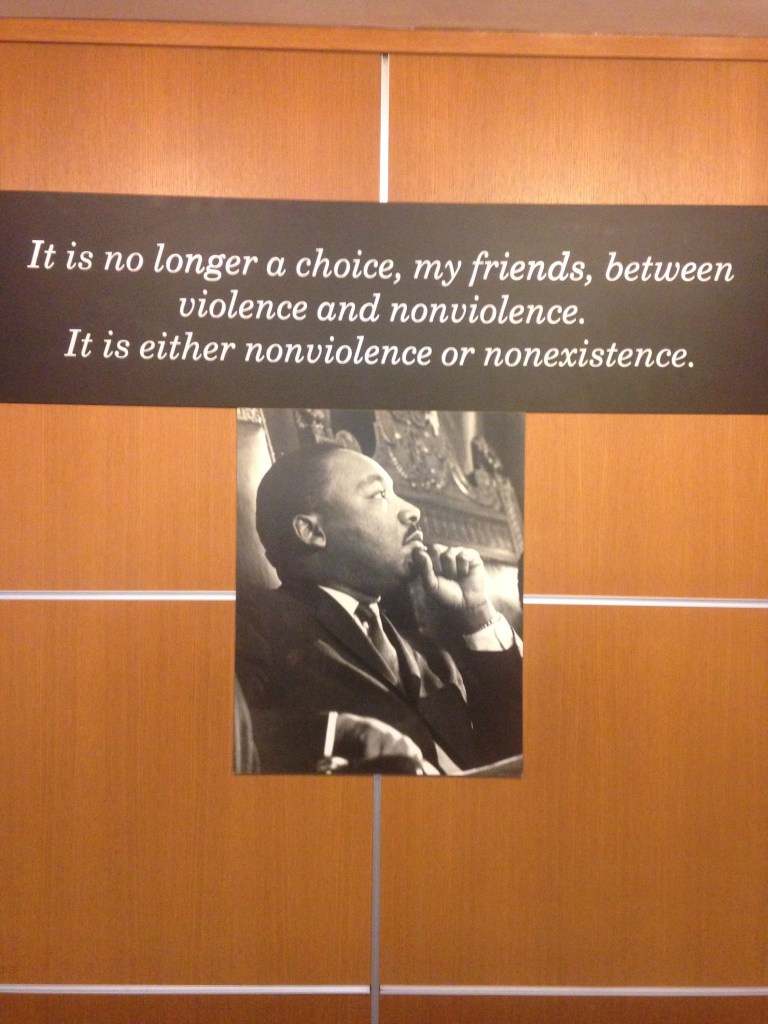
Thomas Merton spoke passionately about nonviolence and peacemaking as did Dr Martin Luther King, Jr. Sadly, they had planned a meeting at The Abbey of Our Lady of Gethsemane but Dr. King was assassinated before they could meet. In the photo above from The King Center, the words of Dr. King say it all: It is no longer a choice, my friends, between violence and nonviolence. It is either nonviolence or nonexistence.
Merton had the following to say in his book, Blessed Are the Meek: The Christian Roots of Nonviolence: Christian nonviolence does not encourage or excuse hatred of a special class, nation, or social group. It is not merely anti- this or that. In other words, the evangelical realism which is demanded of the Christian should make it impossible for him to generalize about “the wicked” against whom he takes up moral arms in a struggle for righteousness. He will not let himself be persuaded that the adversary is totally wicked and can therefore never be reasonable or well-intentioned, and hence need never be listened to. This attitude, which defeats the very purpose of nonviolence — openness, communication, dialogue — often accounts for the fact that some aspects of civil disobedience merely antagonize the adversary without making him willing to communicate in any way whatever, except with bullets or missiles. (Blessed Are the Meek: The Christian Roots of Nonviolence as found in Thomas Merton: Essential Writings, p. 127)
The church, church leaders, and so many others need to have a “come to Jesus meeting” with the Prince of Peace. I believe that this is a life or death situation for the church as we know it today.

