
Verse of the day
Only fear the Lord and serve him faithfully with all your heart, for consider what great things he has done for you.
– 1 Samuel 12:24
Voice of the day
I recognize that faith is always a risk. No matter what we believe, there’s always a chance we might be wrong. But the story of Jesus is just the story I’m willing to risk being wrong about.
– Rachel Held Evans
Prayer of the day
Faithful God, help us to trust you even when the path ahead is uncertain, and to serve you with open hearts, remembering the goodness you have brought into our lives. May our faith be more than what we believe, may it be a risk we are willing to take and a love we are willing to give, even when we do not have all the answers. Amen.
God is Spirit and the Source of all love. Our spiritual journey calls us to seek and find this living God of Love in prayer, worship, spiritual reading, spiritual mentoring, compassionate service to the poor, and good friends. Let us claim the truth that we are loved and open our hearts to receive God’s overflowing love poured out for us. And living fully each day let us share that love in all our wonderful and difficult relationships, responsibilities, and passages. — Finding My Way Home: Pathways to Life and the Spirit
Reflection Question: Out of this list, prayer, worship, spiritual reading, spiritual mentoring, compassionate service to the poor, and good friends, which one might you need to invest more intentional time and engagement?
My soul yearns, even faints, for the courts of the Lord; my heart and my flesh cry out for the living God. – Psalm 84: 2
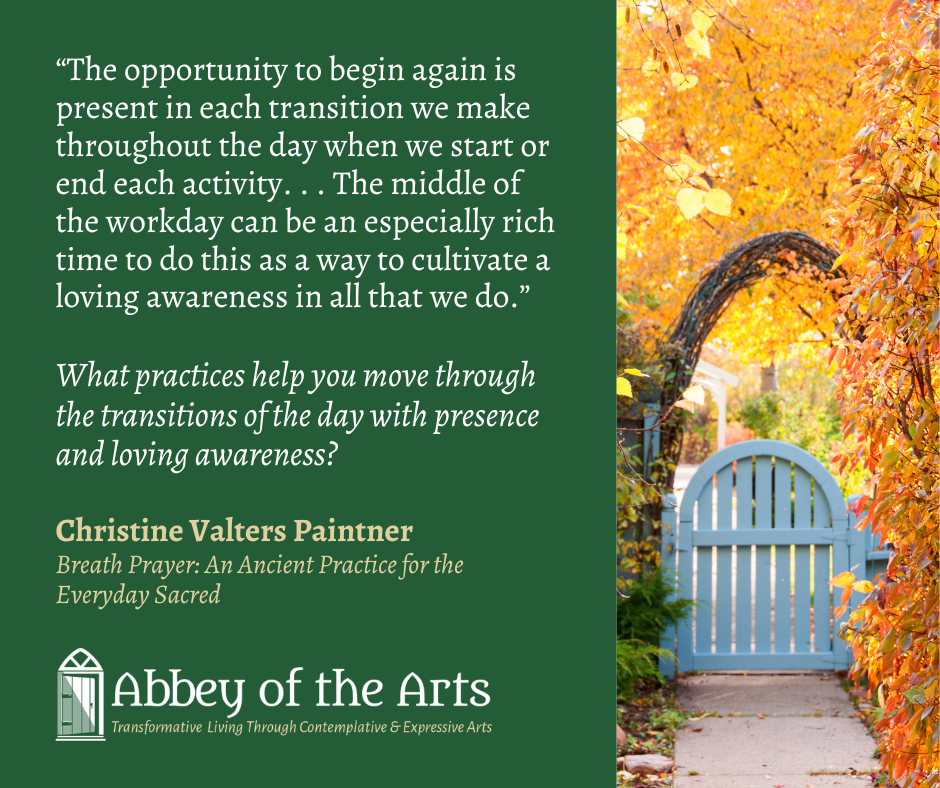
“The opportunity to begin again is present in each transition we make throughout the day when we start or end each activity. . . The middle of the workday can be an especially rich time to do this as a way to cultivate a loving awareness in all that we do.”
—Christine Valters Paintner, PhD, Breath Prayer: An Ancient Practice for the Everyday Sacred
What practices help you move through the transitions of the day with presence and loving awareness?
To register for the self-study companion retreat to the book with extra resources and guidance click here.
Yes, it is possible not to belong to the dark powers, not to build our dwelling place among them, but to choose the house of love as our true home. This choice is made not just once and for all but by intentionally living a spiritual life – praying at all times, practicing lectio divina, and breathing God’s breath each moment. These spiritual practices and other disciplines remind us that we are the Beloved. The classical disciplines are hospitality, spiritual friendship, contemplative prayer, community forgiveness, and the celebration of life. Through regular spiritual practice we gradually move from the house of fear to the house of love. — Spiritual Formation: Following the Movements of the Spirit
Reflection Question: How does spiritual practice enable you to live in the house of love?
For our struggle is not against flesh and blood, but against the rulers, against the authorities, against the powers of this dark world and against the spiritual forces of evil in the heavenly realms. – Ephesians 6: 12
The challenge is to let go of fear and claim the deeper truth of who I am. When you forget your true identity as a beloved child of God, you lose your way in life. You become scared and start doing things not freely, but because of fear. But when you make space for God in your life and begin to listen to God’s loving voice, you suddenly start to realize perfect love. You can claim it, and you can gradually let go of your fear. The fear may come back tomorrow and you will have to struggle, and you can again return from fear to love. Every time you feel afraid, you can open yourself to God’s presence, hear God’s voice again, and be brought back to perfect love that casts out fear and brings in greater freedom. — Spiritual Formation: Following the Movements of the Spirit
Reflection Question: How will embracing your identity of being God’s beloved help you let go of your fear?
The Lord your God is with you, the Mighty Warrior who saves. He will take great delight in you; in his love he will no longer rebuke you, but will rejoice over you with singing. – Zephaniah 3: 17
Verse of the day
He will wipe every tear from their eyes. Death will be no more; mourning and crying and pain will be no more, for the first things have passed away.
– Revelation 21:4
Voice of the day
But resurrection is not just consolation — it is restoration. We get it all back — the love, the loved ones, the goods, the beauties of this life — but in new, unimaginable degrees of glory and joy and strength.
– Tim Keller
Prayer of the day
God of restoration, meet us in the places where grief has left us feeling incomplete, and remind us that no love, beauty, or hope is lost beyond your reach. Teach us to imagine a world where every tear is wiped away, every wound is healed, and every broken thing is made new, and help us bring glimpses of that world into being for one another today. Amen.
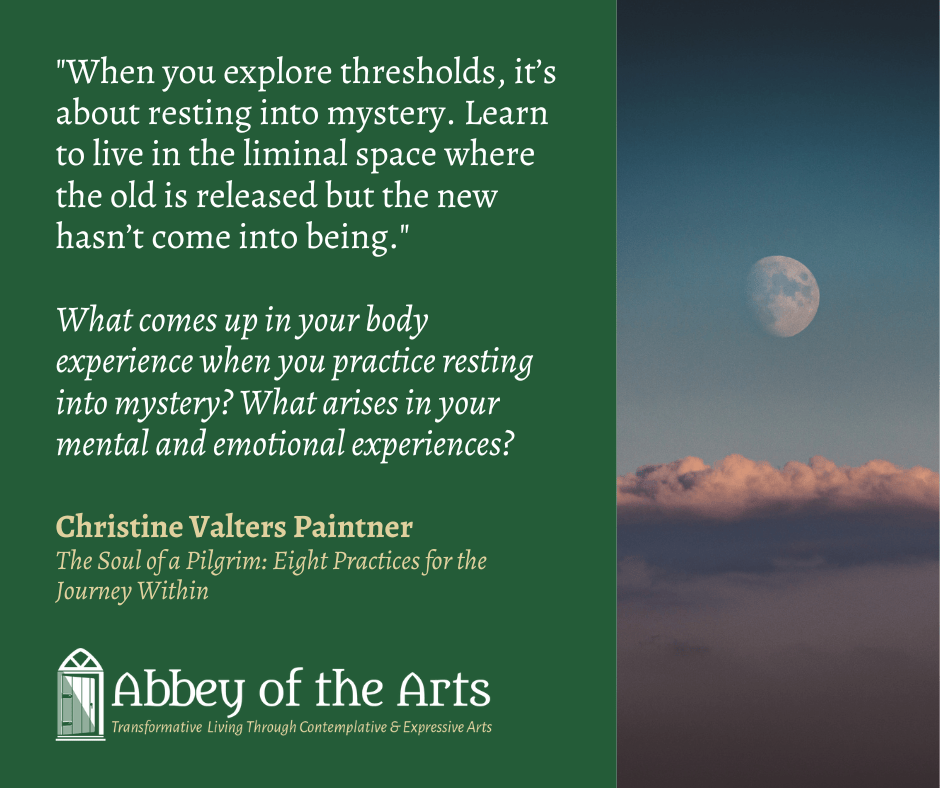
“When you explore thresholds, it’s about resting into mystery. Learn to live in the liminal space where the old is released but the new hasn’t come into being.”
—Christine Valters Paintner, PhD, The Soul of a Pilgrim: Eight Practices for the Journey Within
What comes up in your body experience when you practice resting into mystery? What arises in your mental and emotional experiences?
To register for the self-study companion retreat to the book with extra resources and guidance, click here.
The experience of peace and reconciliation comes when people are very honest and compassionate with one another, when they are vulnerable and open about their mistakes and weaknesses. The seed that falls into broken ground bears much fruit. So perhaps it is wise to begin to shift our thinking. We want to move away from emulating successfulness and begin to dream about a life of fruitfulness. — Finding My Way Home: Pathways to Life and the Spirit
Reflection Question: How have you seen God use your life to bear good fruit?
For by the grace given me I say to every one of you: Do not think of yourself more highly than you ought, but rather think of yourself with sober judgment, in accordance with the faith God has distributed to each of you. – Romans 12: 3
Verse of the day
But even if you do suffer for doing what is right, you are blessed. Do not fear what they fear, and do not be intimidated.
– 1 Peter 3:14
Voice of the day
The point is that no one escapes suffering. It is part of the rhythm of life, part of the process of living. The question then is, for what are we willing to suffer?
– Joan Chittister
Prayer of the day
God of purpose, help us find meaning in the sacrifices we make and the hardships we endure for the sake of love, justice, and one another. May our suffering never be in vain, but become a seed from which compassion grows, hope takes root, and a more just world begins to flourish. Amen.

The present form of the world passes away, and there remains only the joy of having used this world to establish God’s rule here. All pomp, all triumphs, all selfish capitalism, all the false successes of life will pass with the world’s form. All of that passes away. What does not pass away is love. When one has turned money, property, work in one’s calling into service of others, then the joy of sharing and the feeling that all are one’s family does not pass away. In the evening of life you will be judged on love. I wish to affirm that my preaching is not political. It naturally touches on the political – and it touches the people’s real lives – but it does so in order to illuminate those realities and to tell people what it is that God wants and what it is that he does not want.
No one can serve two lords. There is only one God, and that God will either be the true one, who asks us to give things up when they become sin, or it will be the god of money, who makes us turn our back on Christianity’s God. — The Violence of Love, pp. 119-120

