

Love, in fact, is the spiritual life; and without it, all other exercises of the spirit are emptied of content. ~Thomas Merton (The Wisdom of the Desert)
My friend Conor McCourt shared the above quote from Thomas Merton in his newly released, excellent book Whispers from the Sanctuary: A Collection of Mystical Contemplative Reflections. (Whispers from the Sanctuary) Connor invited me to spend some time with this reflection and it was much needed.
There may be a number of reasons that I needed that time for reflection. There is so much divisiveness and vitriol in the headlines and on Social Media (trust me, my diet is incredibly scaled back to help with my sanity) that I have to fight the pull to slip into a dark place… depression stinks! When I look at the amount of trauma Denise and I have experienced these past seven years it is overwhelming. I know from reading his journals that Merton struggled with the world in his day and I can’t even imagine how he would feel today.
Despite all of that, I needed to be reminded what life truly is all about. Jesus summarized the law and the prophets when he commanded that we love the Lord our God with all of our heart, mind, soul, and strength; and to love our neighbor as ourselves. (Matthew 22:37-39) Love, in fact, is the spiritual life. My dear brother Connor reminded me of that today. Thank you, Conor!
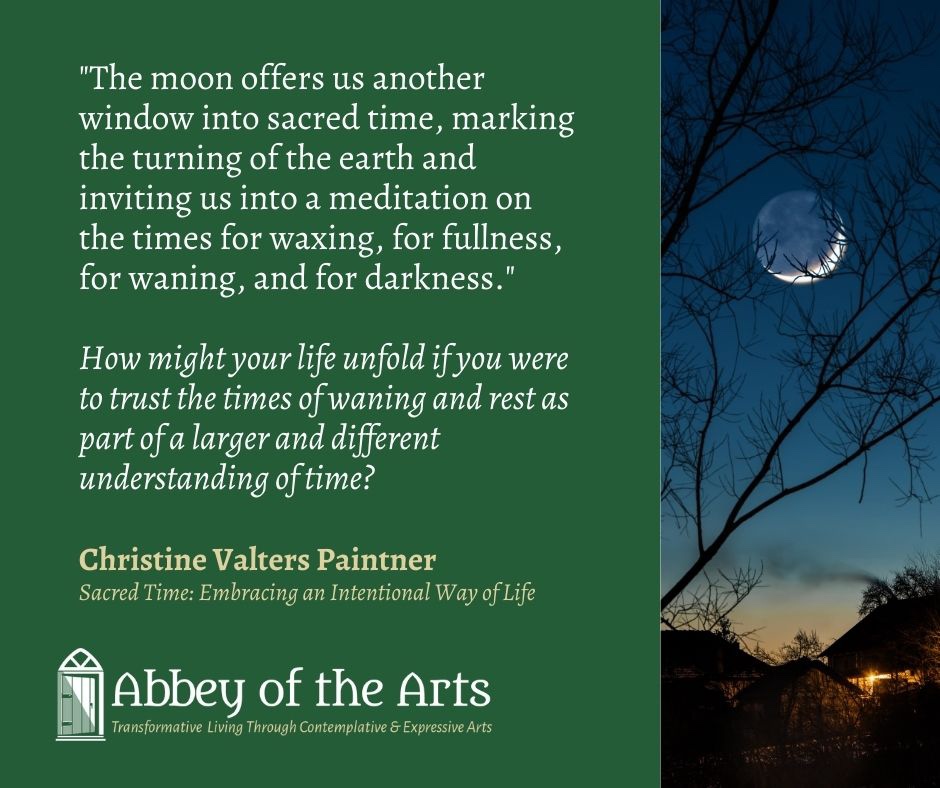
“The moon offers us another window into sacred time, marking the turning of the earth and inviting us into a meditation on the times for waxing, for fullness, for waning, and for darkness.”
— Christine Valters Paintner, PhD, Sacred Time: Embracing an Intentional Way of Life
How might your life unfold if you were to trust the times of waning and rest as part of a larger and different understanding of time?
Verse of the day
Take care that you do not forget the Lord, who brought you out of the land of Egypt, out of the house of slavery.
– Deuteronomy 6:12
Voice of the day
A people without the knowledge of their past history, origin and culture is like a tree without roots.
– Marcus Garvey
Prayer of the day
God of history and story, may we remember the stories and histories we inherit and are a part of.
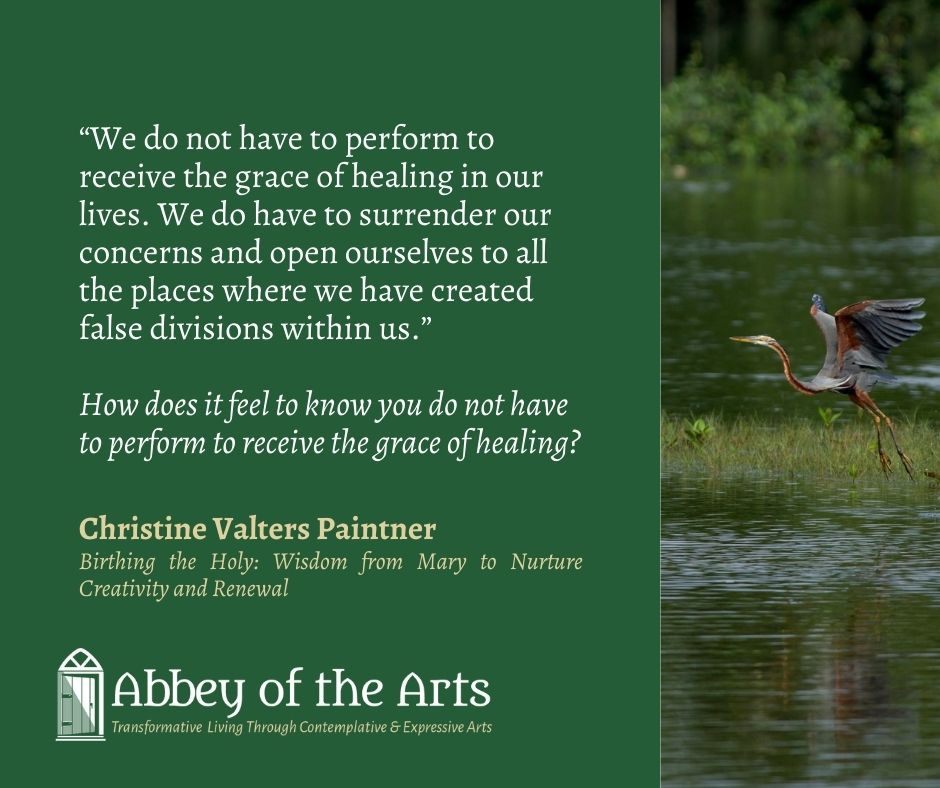
“We do not have to perform to receive the grace of healing in our lives. We do have to surrender our concerns and open ourselves to all the places where we have created false divisions within us.”
— Christine Valters Paintner, PhD, Birthing the Holy: Wisdom from Mary to Nurture Creativity and Renewal
How does it feel to know you do not have to perform to receive the grace of healing?
Imagine having no need at all to judge anybody. Imagine having no desire to decide whether someone is a good or bad person. Imagine being completely free from the feeling that you have to make up your mind about the morality of someone’s behavior. Imagine that you could say: “I am judging no one!”
Imagine — wouldn’t that be true inner freedom? . . . But we can only let go of the heavy burden of judging others when we don’t mind carrying the light burden of being judged!
Can we free ourselves from the need to judge others? Yes, by claiming for ourselves the truth that we are the Beloved Daughters and Sons of God. As long as we continue to live as if we are what we do, what we have, and what other people think about us, we will remain filled with judgments, opinions, evaluations, and condemnations. We will remain addicted to the need to put people and things in their “right” place. To the degree that we embrace the truth that our identity is not rooted in our success, power, or popularity, we can let go of our need to judge. “Do not judge and you will not be judged; because the judgments you give are the judgments you will get” (Matthew 7:1).

“The world can be better if there’s love, tolerance and humility.”—Irena Sendler

Denise and I went for a walk with our cameras on Saturday. It had been quite some time since we had done something like that. It was a true joy to slow down and enjoy the beauty of the Weeks Bay Pitcher Plant Bog. The name (bog) doesn’t do justice to the beauty of that place. Below is a picture of one of the pitcher plants we saw growing there.

The quote from the book A Year with Thomas Merton: Daily Meditations from His Journals spoke to my heart this evening as I remembered our delightful ramble on Saturday.
I got up to the hermitage about nightfall. Wonderful silence, saying Compline gently and slowly with a candle burning before the icon of our Lady. A deep sense of peace and truth, that this was the way things are supposed to be, that I was in my right mind for a change (around the community I am seldom in my right mind). — October 13, 1964 (Dancing in the Waters of Life: The Journals of Thomas Merton, vol 5, 1963-1965)
As we wandered about with our cameras, we both realized that such experiences are life-giving for us. Like Merton said, a deep sense of peace and truth… the way things are supposed to be. We need more of that in our own hectic and busy lives and I believe that it is essential to staying engaged in a meaning-filled way with the church and ministry here in South Alabama.
“Violence is promoting the lie and concealing the truth, while Nonviolence is revealing the lie and promoting the truth.”—Phillip Bradley

Psalm 84 opens with the following verses: How lovely is your dwelling place, O LORD of hosts! My soul longs, indeed it faints for the courts of the LORD; my heart and my flesh sing for joy to the living God. Even the sparrow finds a home, and the swallow a nest for herself, where she may lay her young, at your altars, O LORD of hosts, my King and my God. (84:1-3) Verse three with its promise that even the sparrow and swallow find a home in God’s dwelling place. Of course, that dwelling place was the Temple.
In the sanctuary of the house of the Lord one is supposed to find safety and refuge. The Merriam-Webster dictionary defines sanctuary as a place of refuge and protection. In medieval times, a person who had run afoul of the law could enter a church or cathedral and claim sanctuary. The civil authorities could not enter that space to capture the individual. In the novel, The Hunchback of Notre Dame, Victor Hugo tells the story of Quasimodo the hunchback of Notre Dame and the gypsy woman Esmerelda. Quasimodo brought Esmerelda into the cathedral where she was safe from those who sought to do her harm.
Sanctuary… a place of safety… a place where you could literally in the words of the psalmist, be still and know that God is God… It was this sort of sanctuary where Jesus places his parable about the Pharisee and the tax collector. The Pharisee would have felt right at home in the temple. I wonder how many times he had prayed in this sacred space. The words and the rituals were very familiar to him, and in fact I am sure that he had them committed to memory. I guess you could say that the Pharisee was on his home turf.
Then there was the tax collector. Tax collectors were despised by the Jewish people because they extorted money from them for the empire. The worst of the worst were the Jewish men who worked for the Roman tax collectors. In the eyes of the people, these men had sold their soul to the empire. It appears that he was not at home in the Temple. Cowering in the back, all he could do was beat his chest and say God be merciful to me, a sinner! (Luke 18:13) Feeling like an alien or an outcast he could barely speak any sort of prayer, let alone the ritual prayers that the Pharisee knew by heart. He definitely was NOT on his home turf!
The difference between the prayers of the two men in the sanctuary were like night and day. The Pharisee feeling assured of his salvation and God’s blessings in his own life was the opposite of the tax collector who probably thought the roof was going to collapse on him at any minute because he had no business being in such a sacred place because he was such a miserable sinner.
As I sat with this parable this past week, I kept wondering what the lesson was for me today. What was the lesson that I would share in my sermon on Sunday? A friend of mine who is a pastor had an earth-shattering bit of news from one of the churches she serves. Two of the core members of that church had been killed in a car crash right in front of the church. She wondered how she could possibly preach her prepared sermon on the lectionary text from Luke considering that situation.
In my own personal and professional experiences, I have been in situations where I didn’t know what to pray or what to say. What could I say to the members of a squadron who had two helicopters crash during a training exercise resulting in the loss of thirteen souls? What do I say a few months later when I was a part of the death notification team who had to let the wife of one of the pilots from the same squadron that her husband had been killed overseas on a deployment? What could I say to a parishioner who had to deliver her stillborn baby girl at full term?
I remember well the anguish and the rage that the young widow expressed as she realized that her life and the life of her four children had changed forever. I remember the anguish and questions of the mother who had lost her child. There were no prayers that I could really offer from any sort of a prayerbook. I simply sat with them as I have with so many others and listened as their grief, anger, rage, doubt, and despair was voice by each one. In my own life there have been times where I didn’t have the words to pray or even thoughts to gather.
In the parable, the Pharisee was rather full of himself and content with offering up the prayers he had learned. However, the tax collector didn’t know what to say beyond his raw prayer asking God’s forgiveness on him, a sinner. As I consider this parable in the light of the experiences that I have shared, something comes to my mind and heart. Yes, it is about the exalted being humbled and the humble being exalted. However, the Spirit has challenged me to think about the difference between their prayers. It was the raw honesty of the prayer that the tax collector prayed that hit me. The prayer he offered reminds me of the prayer by the psalmist in Psalm 130 — Out of the depths I cry to you, O Lord. Lord, hear my voice! (vss. 1-2)
Out of the depths… out of the depths Jesus said from the cross My God, My God, why have you forsaken me. (Matthew 27:46) While it was part of a verse from Psalm 22:1 (My God, my God, why have you forsaken me? Why are you so far from helping me, from the words of my groaning?) I am certain that it was a cry of anguish and not a mere reciting of a prayer by Jesus.
In her paper that she presented to the International Thomas Merton Society, Bonnie Thurston shared the following reflection about Merton and the honesty of prayer. Merton says there is only one rule in prayer: “the only rule that there is in prayer is that you never say anything that you don’t mean.” “[E]ach one has to pray in such a way that it is personally real.” (http://merton.org/ITMS/Seasonal/35/35-3Thurston.pdf ) Perhaps that is the lesson we can learn from the parable. Perhaps we are being called to pray in such a way that it is personally real. This has given me a lot to ponder and my hope, dear reader, is that it will offer food for thought and reflection to you as you seek to live, love, and pray.

And once again the words of the prophet speak to this time and place… fifty-four years after his death… oh Lord, hear our prayer as we seek to step away from the insanity of mutually assured destruction. A destruction caused by horrible and divisive politics in this nation and world…
The evil that is in the modern world ought to be sufficient indication that we do not know as much as we think we do. It is a strange paradox indeed that modern man should know so much and still know practically nothing. The paradox is most strange because men in other times, who have known less than we know, have in fact known more. — Thomas Merton, The Ascent to Truth (p. 6)
 Pastor Michael Moore's Blog