
Verse of the day
But [God] said to me, “My grace is sufficient for you, for power is made perfect in weakness.” So I will boast all the more gladly of my weaknesses, so that the power of Christ may dwell in me.
– 2 Corinthians 12:9
Voice of the day
My gift is not my power but willingness to become powerless with other people who are powerless and create a fellowship of the weak and trust that there, God’s healing and power will become visible.
– Henri Nouwen
Prayer of the day
Where we are weak, may your strength and healing power be on full display Lord.
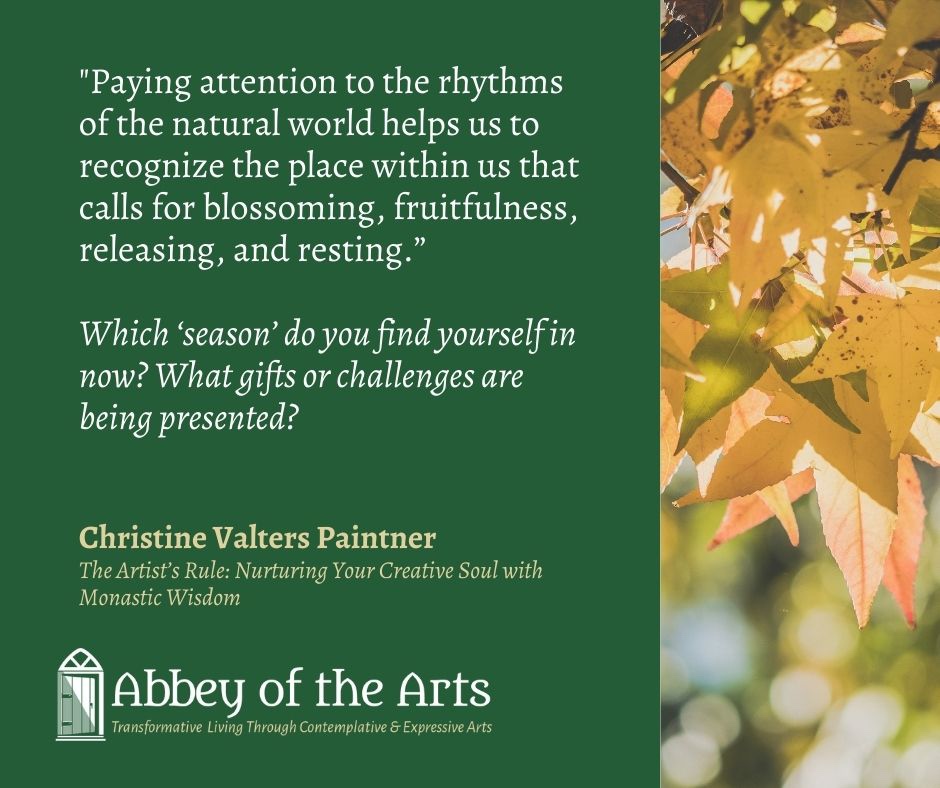
“Paying attention to the rhythms of the natural world helps us to recognize the place within us that calls for blossoming, fruitfulness, releasing, and resting.”
— Christine Valters Paintner, PhD, The Artist’s Rule: Nurturing Your Creative Soul with Monastic Wisdom
Which ‘season’ do you find yourself in now? What gifts or challenges are being presented?

Today’s prompt for a retreat/course that I am taking via Abbey of the Arts centers on a poem that Christine Valters Paintner has written about abundance and scarcity. This is my response to the poem and the question about living in a state of scarcity and trusting in abundance.
This is the line from Christine’s poem that shimmered for me:
Slow us down to see how time expands
when we breathe and pay attention.
The only way we can identify and name the state of scarcity that surrounds us is to slow down and pay attention. As consumerism rises once again during the holiday season, my prayer is to live a life that recognizes and shares abundance with others. To live authentically is the key.
In the Center for Action and Contemplation (CAC) Zoom course that Denise and I are taking (Mystical Sobriety) Dr. James Finley (who was a novice under Thomas Merton) shared the following quote from Merton: With God, a little sincerity goes a long, long way.
I truly believe that living sincerely and authentically is the key for transforming our fear of scarcity (there isn’t enough for us, let alone everyone else) into a heart of abundance that recognizes and freely shares out of the abundance of love, grace, and mercy that surrounds us.
Verse of the day
For I have no pleasure in the death of anyone, says the Lord God. Turn, then, and live.
– Ezekiel 18:32
Voice of the day
People are really dead when you forget about them, and if you think about them, they are alive in your mind, they are alive in your heart.
Prayer of the day
Lord, thank you that you value life; may we keep the memory of those who have passed alive in our hearts.
– Mary J. Andrade
Verse of the day
Pray in the Spirit at all times in every prayer and supplication. To that end, keep alert and always persevere in supplication for all the saints.
– Ephesians 6:18
Voice of the day
For me, prayer is a surge of the heart; it is a simple look turned toward heaven, it is a cry of recognition and of love, embracing both trial and joy.
– Attributed to St. Therese of Lisieux
Prayer of the day
Meet us in our prayers today Lord; thank you for those who intercede for us and may we pray without ceasing.

For those who might need this prayer tonight from the Anglican Prayerbook: Keep watch, dear Lord, with those who work, or watch, or weep this night, and give your angels charge over those who sleep. Tend the sick, Lord Christ; give rest to the weary, bless the dying, soothe the suffering, pity the afflicted, shield the joyous; and all for your love’s sake. Amen.

“The greatest challenge of the day is: how to bring about a revolution of the heart, a revolution which has to start with each one of us.”—Dorothy Day

As a young child in Sunday school and Vacation Bible School, I remember singing the song about wee little Zacchaeus up in the sycamore tree. The emphasis in the song was how wee Zacchaeus was when compared to the rest of the crowd who had gathered along the street to see Jesus walk by.
He is described as short in stature but back then such a phrase wasn’t a simple descriptor; being short was looked upon as a defect or a handicap. In the Levitical laws concerning priests someone who was small of stature was disqualified from being a priest. Daq, the Hebrew word used in Leviticus 21:20, is translated into English as small. Mikros, the Greek the word used in Luke 19:3, is translated into English as small. This background is important if we are to understand a possible reason for Zacchaeus working for the Empire as a tax collector.
Zacchaeus must have been teased by the neighborhood kids and bullied while growing up. The old rhyme “sticks and stones may break my bones, but words can never hurt me” that I heard growing up is an absolute lie. The words cut and they cut deep for the one who is being bullied. As he grew up I imagine that he figured out that if he wasn’t going to be respected by people, they were going to fear him. Despite his success as a very rich and powerful chief tax collector (who had other tax collectors working under him and giving him a cut of their “profits”), life still must not have been very pleasant.
He made his money by cheating the common folks who were his neighbors. He was a traitor to them because he not only stole from them, but he was also an agent of the Empire which was oppressing them. More than likely, Zacchaeus spent a good deal of time looking behind himself to make sure he wasn’t going to be attacked. Did having all that money and power create a nice life for him? I doubt very much it did.
This reminds me of Charles Dickens’ story, A Christmas Carol, and the main character Ebeneezer Scrooge. Scrooge was quite wealthy and made his riches at the expense of Bob Cratchit and others, yet he was a man who lived a lonely life surrounded only by his money. It took three ghosts in the tale to transform Scrooge from the greedy miser to the good Uncle Ebeneezer at the end of the story.
In the case of Zacchaeus, the chief tax collector, it was an encounter with Jesus that changed his life. Swallowing his pride, he climbed up the sycamore tree to be able to look over the crowd to see Jesus. What did he possibly think that Jesus could do for him? Did he think that Jesus would give a traitorous tax collector the time of day? Did he know that Matthew, one of Jesus’ disciples had been a tax collector before Jesus called him to be a disciple?
Whatever the reason, nobody was more surprised than Zacchaeus when Jesus told him to hurry up and come down out of the tree. The crowd didn’t like that one bit and they grumbled about Jesus’ poor judgment… eating with sinners? Oh my! It was the gift of love and forgiveness that transformed the chief tax collector into a man who said in front of Jesus and all of the gathered people: Look, half of my possessions, Lord, I will give to the poor; and if I have defrauded anyone of anything, I will pay back four times as much. (Luke 19:8) His life had been transformed by that one encounter with Jesus.
Zacchaeus experienced the joy found in Psalm 32: Happy are those whose transgression is forgiven, whose sin is covered… I acknowledged my sin to you, and I did not hide my iniquity; I said, “I will confess my transgressions to the LORD,” and you forgave the guilt of my sin. (verses 1 & 5) In that moment his life was transformed by the love, mercy, and forgiveness of God which Jesus gave to him.
In a talk on prayer that Thomas Merton gave to the novices at the monastery (as shared by one of his former novices, Dr. James Finley in his podcast Turning to the Mystics: Season Four, Episode Eight, A Coaching Session on Lectio), Merton shared these thoughts on prayer. The way we would begin in prayer is that we belong to God. And all the prayer starts and unfolds out of that knowing that we belong to God. We are trying to get past the topic of prayer to this deep experience that we belong to God. We are God’s beloved. Renewing our faith that we are sitting there in God’s presence, God is all about us and within us, closer to us than we are to ourselves.
We belong to God; we are God’s beloved. That is what Zacchaeus experienced as he climbed down from the sycamore tree and shared his transformation with all who were in earshot. What a radical transformation! I invite you to join me as together we climb out of our own sycamore trees, experience the radical love that Jesus offers, and share that love with others!
“The call for human beings to ‘love your enemies’ means wanting wholeness and well-being and life for those who may be broken and sick and deadly. It was meant to be a cornerstone of an entirely new process of disarming evil; one which decreases evil instead of feeding it as violence does.”—Angie O’Gorman

There is in us an instinct for newness, for renewal, for a liberation of creative power. We seek to awaken in ourselves a force which really changes our lives from within. And yet the same instinct tells us that this change is a recovery of that which is deepest, most original, most personal in ourselves. To be born again is not to become somebody else, but to become ourselves. — Thomas Merton (Choosing to Love the World: On Contemplation) edited by Jonathan Montaldo)
I first read the above quote in Christine Valters Paintner’s book, The Artists Rule: Nurturing Your Creative Soul with Monastic Wisdom. Christine is the Abbess of the online community known as Abbey of the Arts and I am deeply honored to be a part of the Abbey’s Wisdom Council.
I have been sitting with Merton’s quote a good portion of today. I love how Merton invites us to consider that the transformation is actually becoming ourselves. Becoming ourselves. This invitation is to recover whom we were created to be. Imago Dei… made in the image of God. After God created humans in God’s own image, God looked at all of creation and called it very good. (Genesis 1:26-31)
Looking at it this way, being born anew is returning to our original created state… imago Dei… image of God… very good. Perhaps if we looked at each other from that perspective, the world wouldn’t be seen as an us versus them situation but instead it would be a united we.
 Pastor Michael Moore's Blog