

The sun has set and the Vesper Lights flicker and glow
It has been a wonderful day of ministry
Lord, thank you for sacred conversations
Lord, thank you for time in your creation
Lord, thank you for your sacred calling
In the midst of it all
I thank you Lord, for your Spirit’s presence
Now as my eyelids grow heavy
I lift this humble prayer to you
Dona Nobis Pacem
Grant Us Peace
A wee prayer from the heart of your Padre…

The sun has set and the Vesper Lights flicker and glow
Another day of ministry
Walking with folks through difficult times
Worshipping in our Outdoor Chapel
Praying during the Season of Peace
Enjoying the wonders of your Creation
Thank you Lord, for these blessings
Now as my eyelids grow heavy
I lift this humble prayer to you
Dona Nobis Pacem
Grant Us Peace
A wee prayer from the heart of your Padre…
“For the Celtic monks, thresholds were sacred places. The space or the moment between—whether physical places or experiences—is a place of possibility. Rather than waiting being a nuisance or arriving with a sense that you are wasting time, the pause at a threshold is an invitation to breathe into the now and receive its gifts.”
— Christine Valters Paintner, PhD, The Wisdom of the Body: A Contemplative Journey to Wholeness for Women

The sun has set and the Vesper Lights flicker and glow
A day of rest and reflection
A time to recharge drained batteries
Thank you Lord, for this brief respite
An evening of heartache and challenge
Stories of our neighbors
The neighbors whom too many demonize
There is enough room for us all
There is enough room at your Table
Lord forgive us
Lord challenge us
May we open the doors of our borders
May we open the doors of our hearts
Lord in your mercy hear this humble prayer
Dona Nobis Pacem
Grant Us Peace
A wee prayer from the heart of your Padre…
Beautiful, Malcolm!

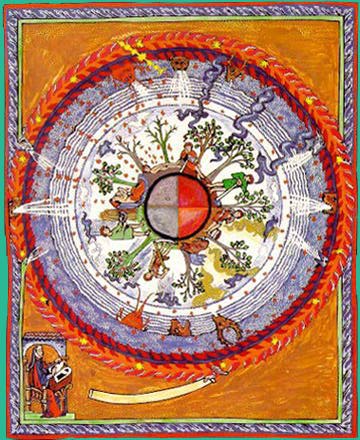 Tending the tree of Life by Hildegard of Bingen
The 17th of September is the feast day of Abbess Hildegard of Bingen, a remarkable and prophetic woman, who described herself as ‘a feather on the breath of God’, and whose many works in theology, music, visual art, poetry and drama are still inspiring people today. Indeed she is coming more and more into her own, as one of her key ideas ‘Viriditas’, or the greening and life-renewing work of the Holy Spirit, seems especially apposite for our time. See this page on her by a contemporary Benedictine.
The photo below is by Margot Krebs Neale
I wrote this sonnet at Launde Abbey in Leicestershire. It is published in my second volume of poetry The Singing Bowl, Canterbury Press, available on Amazon in both the US and the UK
As always you can hear the sonnet by clicking…
View original post 120 more words

The sun has set and the Vesper Lights flicker and glow
Thank you Lord, for this day
Thank you for the tremendous staff I work with
Thank you for the ministry you have called me to
Thank you for dear friends
Thank you for opportunities to enjoy your creation
Now, as my eyelids grow heavy
I lift this humble prayer to you
Dona Nobis Pacem
Grant Us Peace
A wee prayer from the heart of your Padre…

The sun has set and the Vesper Lights flicker and glow
A powerful Lord’s Day in worship
A wonderful afternoon of walking and enjoying Creation
An evening relaxing at home
For all of your gifts, Lord
For the friendships we celebrate
For all good gifts we thank you
Now as my eyelids grow heavy
I lift this humble prayer to you
Dona Nobis Pacem
Grant Us Peace
A wee prayer from the heart of your Padre…

First Reading – Luke 2:33-35
Second Reading – John 19:25b-30
Sermon – A Mother’s Sorrow: Mary’s Story

The sun has set and the Vesper Lights flicker and glow
The day began with a walk and reflection
The wee little mouse made us pause
We paused and enjoyed its company
Today we said farewell to two wonderful women
As we walked once more through the Valley of the Shadows
You were present, Lord
Your Peace was in our midst
To end the day with good music and dear friends
What a blessing indeed
Now as my eyelids grow heavy
I lift this humble prayer to you
Dona Nobis Pacem
Grant Us Peace
A wee prayer from the heart of your Padre…
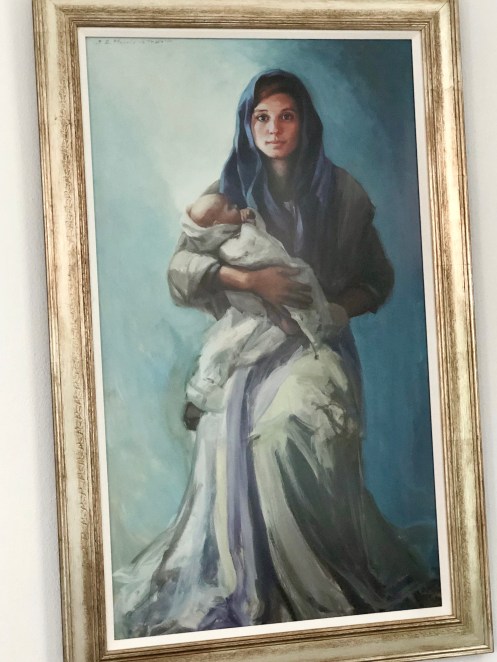
When we were on our Ignatian Silent Retreat at Spring Hill College this past June, I spent a lot of time with this painting of Mary, the Mother of Jesus in the old wood framed Sodality Chapel. This portrait was painted by Spring Hill Alumnae and Mobile, AL Artist, Stephanie Morris. The model was a Spring Hill College student. As I spent time with Mary, her eyes truly reached out and spoke to my heart and soul.
This is the final sermon in the series on The Women in Jesus’s Genealogy. Three of the women were not in his Genealogy but their stories were well worth exploring. I have explored the stories and contemplated the lives of Eve (Denise preached that sermon), Ruth, Rahab, Bathsheba, The Canaanite Woman at the Well, Mary Magdalene, and now Mary, the Mother of Jesus.
As I have written and preached before, Mary is often problematic for Protestants. In part the difficulty is in the way she is elevated in the Catholic Church. Yet many Catholic folks I know don’t believe she should be elevated to the level of God any more than Protestants do. Yet as a part of the Reformation, Mary was pretty much thrown out all together. My own journey as a Presbyterian with Mary has been challenging as well as enlightening. I have come to a deeper understanding of Mary. I truly admire her and have learned much from sitting with her. So, let’s get to the subject of this final reflection in this series.
The two scripture readings that I am using tomorrow bookend the life of Jesus. In Luke 2:33-35 we hear the following somber news after Simeon blesses Jesus. In context, Jesus was brought to the Temple by his parents. Simeon was overjoyed that the long-awaited Messiah had finally come and he was alive to see it.
And the child’s father and mother were amazed at what was being said about him. Then Simeon blessed them and said to his mother Mary, “This child is destined for the falling and the rising of many in Israel, and to be a sign that will be opposed so that the inner thoughts of many will be revealed—and a sword will pierce your own soul too.” – Luke 2:33-35
Can you imagine? As I think about Mary hearing the last part of the blessing on top of all that she had heard at Jesus’s birth I am overwhelmed! A sword will pierce your own soul too!
As we remember the birth narrative, we can see how Mary’s life with Joseph didn’t exactly begin normally. They didn’t have a typical betrothal. The gossip must have flown around as she began to show and as the story of God overshadowing her came out. At one point, Joseph even considered quietly divorcing her. Yet God interceded through the angelic visitors and they found their way forward as a couple.
In the birth narrative, following the visits of the Shepherds and their stories of angels, she pondered all that she had seen and heard in her heart. Forty days later the family goes to the Temple for what should be the standard purification of Mary following the birth of Jesus. Joseph and Mary were also supposed to present and dedicate their first-born son to God in order to fulfill the law in Exodus 13.
As I said earlier, when the 40-day old infant Jesus was presented to Simeon and he immediately proclaimed his joy in a very familiar passage of Scripture.
Simeon took him into his arms and blessed God: God, you can now release your servant; release me in peace as you promised. With my own eyes I’ve seen your salvation; it’s now out in the open for everyone to see: A God-revealing light to the non-Jewish nations, and of glory for your people Israel. – Luke 2:29-32 (The Message Translation)
There was so much for Mary to ponder in those early days. There would be so much more to ponder as Jesus grew from a baby to a young boy and finally into a man. Yet lurking in the back of her mind must have been the words of Simeon: a sword will pierce your own soul too.
Scripture is quiet when it comes to the growing up years of Jesus. After the incident in the Temple where the twelve-year-old Jesus was amazing the religious leaders, we hear nothing about his life until he appears as a part of the crowd following John the Baptist and asks John to baptize him.
The three years of Jesus’s public ministry must have provided much to contemplate and be concerned about for his mother. More and more was poured into her heart as she followed Jesus, listened to his teaching, and watched the miracles.
Yet in the end, as the road led to Jerusalem for the final time her heart must have been heavy. As the intrigue unfolded did she remember the words of Simeon? Did she feel a pain and a piercing beginning in her heart?
The second reading from John 19:25b-30 is, I believe where her heart was pierced and broken as she watched her son dying an agonizing death on the cross. I can’t even imagine the pain as Jesus looked down from the cross and said goodbye to his mother. Yet in the midst of the pain, there was a loving and tender moment as he made sure that the woman who had given birth to him and raised him would be cared for.
Meanwhile, standing near the cross of Jesus were his mother, and his mother’s sister, Mary the wife of Clopas, and Mary Magdalene. When Jesus saw his mother and the disciple whom he loved standing beside her, he said to his mother, “Woman, here is your son.” Then he said to the disciple, “Here is your mother.” And from that hour the disciple took her into his own home. – John 19:25b-27
The story has come full circle and now, with her son dying on the cross, her heart was pierced in a way it had never been pierced before. It was with this woman that I spent so much time reflecting in the Chapel at Spring Hill College. As I used the Ignatian practice of placing myself into the story, I felt her pain in a way I had never done before. During that week, I came to know Mary in a way that I hadn’t in the majority of my years in ministry.
As I looked into her eyes, I saw the pain and the peace. A wise woman who was forced to learn such harsh lessons at an early age. A woman who had to watch helplessly as the Empire executed her son. A woman who had to watch as the faith community turned its back on Jesus, and in essence, on her as well.
As I sat with her in the Chapel and as I have continued to do ever since, I felt a peace that I didn’t expect. As I sat with her, I heard her say “I am not God. I am the Mother of Jesus. Don’t worship me. Listen to me and learn from my story.”
May we do that as we consider Mary and the place she holds in the life of Jesus and in our own faith journey as well.

