
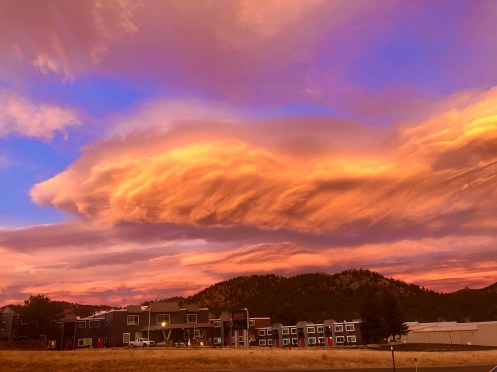
This past weekend Denise and I were assisting our friend Nadine with some logistics for the Songwriter’s Retreat she was hosting. Saturday in the late afternoon we picked up and then delivered the food which had been ordered. After dinner and the songwriter’s circle, we prepared to go to the concert which was being put on by the three weekend instructors.
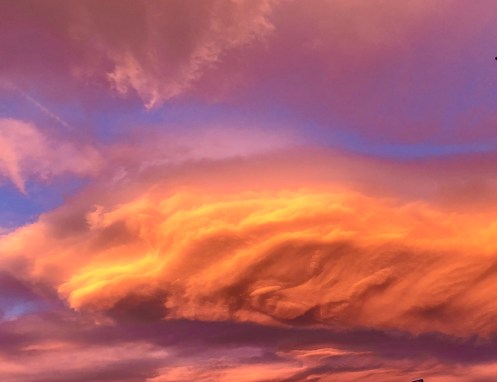
As Clay (one of the instructors) and I walked outside, we both looked up and were blown away by the sunset! In his song, “Rocky Mountain High,” John Denver sings about seeing it raining fire in the sky. It doesn’t always happen but when it does… wow! Clay looked up and said to me, “How can anyone look up at such beauty and not believe in God!” It was indeed one of those divine ah-ha moments.
I have been thinking about that conversation and about beliefs ever since our conversation on Saturday. What actually defines “beliefs” and how do we express them is a question to ponder. On the one extreme is the concept of rigid doctrine being the core of one’s belief system. I once heard a pastor in a funeral service tell the grieving widow and all of us who had gathered at the base chapel that “Bible Doctrine will bring you comfort.” Needless to say, I was speechless. I had been the chaplain on the notification team who had to break the news of the young Captain’s death overseas in a war zone to his wife with three small children. The anger and the sorrow she expressed at that moment wasn’t going to be comforted by doctrine.
On the other hand, I have talked with far too many people who have been beaten by doctrine and shoved out of a community of faith by the rigid “doctrine police!” The protectors of “right doctrine” (whatever that may be) end up doing more damage in the name of religion, faith, and belief than they do any good.
Pondering these things, I came across this quote from Thomas Merton in his book Conjectures of a Guilty Bystander. It put to words some of what I had been thinking this weekend. We believe, not because we want to know, but because we want to be. And supernatural faith responds to the mystery of that natural faith which is the core and center of our personal being, the will to be ourselves that is at the heart of our natural identity. (p. 11)
This is the movement of faith and belief from the head to the heart which Howard Thurman talked about in one of his audio lectures. Interestingly enough, his autobiography is titled: With Head and Heart. Here is the quote: Don’t ask yourself what the world needs. Ask yourself what makes you come alive, and go do that, because what the world needs is people who have come alive.
When our faith moves from our head to our heart, then the true work of the Spirit truly takes root and begins to transform lives. The brilliant sunset then becomes a magnificent work of divine artistry which inspires us to simply be still in the presence of God’s awe and wonder.
“Consider Earth as our original monastery. Earth is the place where we learn our most fundamental prayers, hear the call of the wild arising at dawn that awakens us to a new day, participate in the primal liturgy of praise unfolding all around us, and experience the wisdom and guidance of the seasons.”
— Christine Valters Paintner, PhD, Earth, Our Original Monastery: Cultivating Wonder and Gratitude through Intimacy with Nature
Where in nature do you most often experience a sense of sanctuary and renewal?
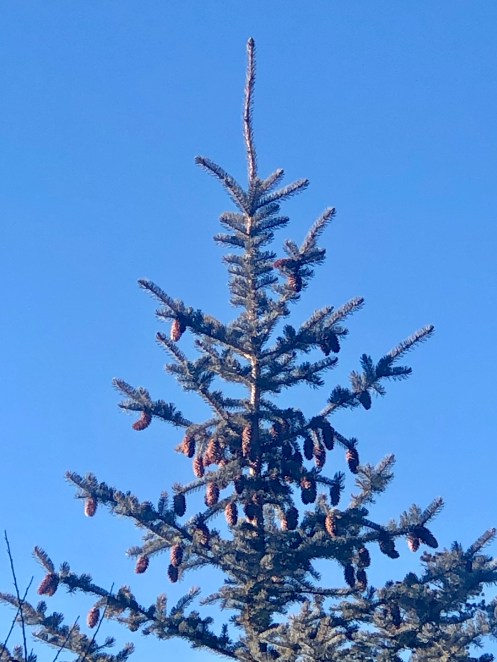
The sun has set and the Vesper Lights flicker and glow
It has been a long day, Lord
Breaking bread at your Table
A time of study and reflection
An evening of music with dear friends
A time to simply Be Still
Now as my eyelids grow heavy
I lift this humble prayer to you
Dona Nobis Pacem
Grant Us Peace
A wee prayer from the heart of your Padre…

It has been a long and eventful weekend. It has been filled with music and laughter. It has also been a time to walk with families through the Valley of the Shadows. We are also walking with dear ones who are walking through the same Valley with their puppy’s who are family. My heart is heavy as I lift prayers for them.
As we face a new week… as Monday approaches… I look to the Lord for a sign… as I read in Merton’s Conjectures of a Guilty Bystander tonight, these words hit my heart. We look for signs of hope and God’s presence. Merton saw such signs in a wonderful way.
This morning before Prime, in the early morning sky, three antiquated monoplanes flew over the monastery with much noise, followed by a great heron.
In the midst of the world’s noise, God spoke through the great heron. The early Celts in Ireland spoke of the Wild Goose as a representative of the Holy Spirit. My prayer tonight is that the Spirit will indeed follow, much as the heron did, the chaos and noise of this world. May the Wild Goose fly and remind us to look for the Spirit’s presence and guidance in our lives.
The sun has set and the Vesper Lights flicker and glow
The day began by walking with a family
We walked through the Valley of the Shadows
An afternoon of reading and reflection
Followed by dinner with dear friends
We witnessed an amazing sunset
Then an evening of music
For a full day we give you thanks, Lord
Now as my eyelids grow heavy
I lift this humble prayer to you
Dona Nobis Pacem
Grant Us Peace
A wee prayer from the heart of your Padre…

I took a Contemplative Walk back in May of 2014 as a part of a Men’s Contemplative Retreat at St Bernard’s Abbey in Cullman, Alabama. It is a reminder to me that we need a balance of contemplation and action as we live the life Christ calls us to live. Today’s readings challenge us to live our lives in a way that is sadly very different from the world and even the church. To live out the Beatitudes and Micah 6:8 require action that comes from a place of spiritual depth.
I have been contemplating these passages all week. Actually, they are a huge part of my own discernment process and way of ministry. For so many years as an Air Force Chaplain I saw both the beauty of peace and the ugliness when there is no peace. Ironically, my first Reserve assignment (the summer between my second and third year of seminary) was spent at Carswell Air Force Base in Fort Worth, Texas. It was the home of Strategic Air Command’s (SAC) 7th Bomb Wing. They had fully-loaded B-52 Bombers and KC-135 Tankers on alert 24/7. That meant that the aircraft and crews were “on call” to respond immediately to the call to fly and bomb targets. In 1985, we were still in the midst of the Cold War and this was a new experience for this kid from Austin, Minnesota. Nuclear weapons and drills made the drills we used to have in school look like a sad joke. Trust me, gathering in a hallway or getting under your desk was not going to save anyone from a nuclear holocaust.
The ironic thing about SAC was it’s “motto.” Peace is our Profession was on every piece of letterhead and on the sign at the entrance to the base. How did we keep peace? By stockpiling enough nuclear weapons to match the Soviets bomb, missile, and bomber… sounds insane, doesn’t it. This was the world view which Thomas Merton, Daniel Berrigan, Dorothy Day, Philip Berrigan, and others worked to dismantle.
Blessed are the peacemakers… the peacemakers Jesus was talking about weren’t the military or government folks. He was talking about those who were willing to turn the world upside down. You see, in Jesus’s upside down economy, the poor were elevated and the rich were brought down from their golden thrones. Jesus was the one who said that those who live by the sword will die by the sword. It was Jesus who told Peter to put away his sword and healed the man who’s ear had been hacked off by Peter at Jesus’s arrest in the Garden of Gethsemane.
Blessed are the peacemakers… when someone strikes you on your cheek, offer them the other… how many times should we forgive, Lord? Peter thought seven times was enough… no, try seventy times seven said Jesus. Do you see how opposite this is to what we often see today?
Justice equals retribution, vindictiveness, and getting even. Walking tall while carrying the biggest stick to threaten others is how too many treat people. Is this what the Lord requires? Is this what the church is supposed to be teaching (as the church arms itself to the teeth to “protect the American way”)? I think not.
What does the Lord require of you asked the Prophet Micah. To do justice… to love kindness and mercy… to walk humbly with God. There’s no room for threats and bullying here. There is only room for justice tempered by mercy. There is only room for love, kindness, forgiveness, and reconciliation. There is no room for ego or hubris because we are called to walk humbly with God and with one another.
Dear reader, this is the sort of peaceful profession I see as our calling. May God give us the strength and the persistence to do this! Do Justice! Love Mercy/Kindness! Walk Humbly with God and with one another!

Today is Saint Brigid’s Day. It is also the Celtic Festival of Imbolc. The ancients celebrated this day as the beginning of Spring. It was also the time when the ewes were beginning to give birth to their new lambs.
There are a tremendous number of legends surrounding Imbolc/Brigid’s Day. One legend from Ireland tells the tale of a young girl who was charged with watching the sheep and especially the ewes who were very pregnant. In the night a ram knocked her over and seemed to emphasize that something was wrong and she was to follow him. As she made her way, often tripping and falling, the ram always waited for her and kept her going forward. They came to the ewe and it was obvious that the ewe and her baby were in distress. She had been praying to Brigid the entire time she was following the ram. The Saint appeared and helped the ewe give birth to a healthy lamb. My child, Brigid said to the girl, you had been calling out to me so of course I came to help you and this precious family.
This prayer attributed to Brigid is appropriate on this or any day. It is a call to hospitality. Brigid’s hospitality is shown not just to the King of Kings, but to all of God’s Children!
Brigid’s Feast
I should like a great lake of finest ale
for the King of kings.
I should like a table of the choicest food
for the family of heaven.
Let the ale be made from the fruits of faith
and the food be forgiving love.
I should welcome the poor to my feast,
for they are God’s children.
I should welcome the sick to my feast,
for they are God’s joy.
Let the poor sit with Jesus at the highest place,
and the sick dance with the angels.
God bless the poor,
God bless the sick,
and bless our human race.
God bless our food,
God bless our drink;
all homes, O God, embrace.

As we prayed Morning Prayer this morning before I headed out to officiate at a funeral, I thought of Brigid’s hospitality. While driving home afterwards, I chuckled to imagine that Thomas Merton, who’s birthday was yesterday, would have loved to enjoy Brigid’s feast!
Both of these saints have been teaching me a lot over the past few years. It is no coincidence in my thinking that their days of remembrance are one day apart!
Even though Merton was seeking to escape from the world in becoming a contemplative; later in life he would write many times in his journals about spending time with friends who were like family to him.
His visitors to the hermitage often came to share stories and to seek his guidance. When he was off the monastery grounds with friends, he would share stories and laughter over dinner and drinks. Evidently he had a great wit and a belly laugh you couldn’t miss.
Someone once commented on the fact that Merton’s Hermitage had several chairs on the front porch. Why would a Hermit have a need for so many chairs? This actually fits into the Rule of St. Benedict which the Trappists followed. In a wonderful part early in Conjectures of a Guilty Bystander, Merton wrote about the misunderstanding of Benedict’s rule.
St. Benedict never said the monk must never go out, never receive a letter, never have a visitor, never talk to anyone, never hear any news. He meant that the monk should distinguish what is useless and harmful from what is useful and salutary, and in all things glorify God. Rejection of the world? The monk must see Christ in the pilgrim and stranger who come from the world, especially if they are poor. Such is the spirit and letter of the Rule.
So on this day when we celebrate St. Brigid and her love for all of God’s creatures, I could would love to join Brigid and Thomas Merton at her Feast!

*The picture at the top of the blog is of a Ranger Cabin on Old Fall River Road in the Rocky Mountain National Park.
**The icons (which can be purchased from Rabbit Room Arts) of Brigid and Thomas Merton were commissioned by Christine Valters Paintner, the Abbess of our on-line community, Abbey of the Arts (Abbey of the Arts)
A powerful reflection, Jake!
Fear is your friend. At least, fear can be your friend. That’s because fear has something vital to teach us….
— Read on jakeowensby.com/2020/01/31/how-to-overcome-fear/

The sun has set and the Vesper Lights flicker and glow
Yikes! It’s the last day of January?
A wonderful day with my sweetheart
A time of music with good friends
A time of reading and reflection
As we look to a new month
May you guide us each and every day, Lord
Now as my eyelids grow heavy
I lift this humble prayer to you
Dona Nobis Pacem
Grant Us Peace
A wee prayer from the heart of your Padre…

