
Verse of the day
For he is our peace; in his flesh he has made both groups into one and has broken down the dividing wall, that is, the hostility between us.
– Ephesians 2:14
Voice of the day
We need to talk about differences; we can’t just sweep them under the rug. Differences do not have to divide us; they can enrich us.
– Ada María Isasi-Díaz, “Faith at the Tipping Point”
Prayer of the day
Creation shows your love of diversity and difference God; may your people model that same love.

Thomas Merton wrote the following to Ethel Kennedy, the wife of Senator Robert F Kennedy, the brother of President John F Kennedy. Written in December of 1961, Merton’s words are eerily relevant to us today. I’ll let Merton speak for himself and let you, dear reader, judge it’s relevance in your own life as I have in mine.
I think it is going to be of great importance, in the next few months and years, if Americans can regain their healthy respect for reason, for the light of intellect, and get rid of this shallow contempt for “eggheads.” They must learn to respect thought and stop idolizing psychopathic goofs. God knows, this is going to take a miracle. There are plenty of wise and sane men in the country, and they are able to be articulate. They can do a tremendous amount. (Cold War Letters, p. 28)
I have been meditating on the story of the prodigal son. It is a story about returning. I realize the importance of returning over and over again. My life drifts away from God. I have to return. My heart moves away from my first love. I have to return. My mind wanders to strange images. I have to return. Returning is a lifelong struggle. . . . I am moved by the fact that the father didn’t require any higher motivation. His love was so total and unconditional that he simply welcomed his son home.

This past Sunday I talked about the importance of not dehumanizing the “other” but seeing them as our sibling who is created in the image of God. This runs counter to what I often saw and heard in the military about “the enemy” who was demonized. Merton’s letter to Dorothy Day on December 20, 1961 speaks directly to my premise that we cannot demonize others. The letter is found in the book Cold War Letters (p. 30-31)
The basic thing in Christian ethics is to look at the person and not at their nature. That is why natural law so easily degenerates, in practice and casuistry, to jungle law which is no law at all. Because when we consider “nature” we consider the general, the theoretical, and forget the concrete, the individual, the personal reality of the one confronting us. Hence we can see him not as our other self, not as Christ, but as our demon, our evil beast, our nightmare. This, I am afraid, is what a wrong, unintelligent, and unchristian emphasis on natural law has done.
Persons are known not by the intellect alone, not by principles alone, but only by love. It is when we love the other, the enemy, that we obtain from God the key to an understanding of who he is, and who we are. It is only this realization that can open to us the real nature of our duty, and of right action.
In today’s divisive world, we could use this challenge and reminder. After all, Jesus said to love our neighbors and he didn’t put any qualifications on that statement.
Verse of the day
Oppressing the poor in order to enrich oneself, and giving to the rich, will lead only to loss.
– Proverbs 22:16
Voice of the day
You don’t get to have solidarity with the marginalized and popularity with the powerful.
– Megan DeFranza, episode 19 of The Bible for Normal People
Prayer of the day
God, grant us the privilege of breaking bread with those who the powerful have marginalized
Though the forces of evil infecting whole nations and peoples are often hidden, complex, and elusive, we are called, as Christians, to unmask and expel them in the Name of the God of Love….
As long as national security is our primary concern and national survival more important than preserving life on this planet, we continue to live in the house of fear. Ultimately, we must choose between security—individual, social, or national— and freedom.
Freedom is the true human goal. Life is only true if it is free. An obsessive concern for security freezes us; it leads us to rigidity, fixation, and eventually death. The more preoccupied we are with security the more visible the force of death becomes, whether in the form of a pistol beside our bed, a rifle in our house, or a Trident submarine in our port….
We must find a way to go beyond our national security obsession and reach out and foster life for all people, whatever their nationality, race, or religion.
A powerful reflection from my seminary classmate, colleague n ministry, and friend, Shirley!
Jeremiah had the unenviable task of speaking truth to a people convinced of their own wisdom and invincibility. From the beginning of his prophetic ministry, he called people to repentance.
— Read further on shirleyhobsonduncanson.com/2022/09/12/the-heavy-work-of-prophesy/
Verse of the day
The memory of the righteous is a blessing, but the name of the wicked will rot.
– Proverbs 10:7
Voice of the day
… Christian memory should never be subject to the agenda of the state or the interests of the empire. Rather, the people of God remember a God who delivers those who cry out in anguish for relief from the suffering that the powerful inflict upon them.
– David Leong, “Christians must challenge the selective memory of #NeverForget”
Prayer of the day
God of perfect memory, in the aftermath of tragedy, may we strive to remember rightly, for to do so is an act of justice.

Shortly after we moved to Orange Beach, Denise and I decided to go hiking in the Gulf State Park. You might call it going for a walk since there wasn’t any elevation change like we experienced in the past while hiking in the Rocky Mountain National Park. What I found intriguing with this friend was how it meticulously searched for and ate grass that it could find. I guess that when you are a tortoise and when you are in a hot and sandy environment it takes time to find something to eat! Our little friend continued its patient and persistent journey and found sustenance.
So, what does this have to do with the Gospel reading for the Fourteenth Sunday after Pentecost? Well, let’s unpack Luke 15:1-10 and find out! Jesus was on his way to Jerusalem and had been challenging the crowds who were following him along with the Pharisees and scribes following at a distance. As the fifteenth chapter opens, all the tax collectors and sinners were coming near to listen to Jesus (verse 1). The Pharisees and scribes were getting closer to listen for a very different reason. This fellow welcomes sinners and eats with them (verse 2). How dare Jesus hang out with the riffraff of society! We wouldn’t be caught dead hanging out with those people!
Jesus knew good and well why he was hanging out with the tax collectors and other sinners instead of hanging out with the religious elite. His message wasn’t for the smug and self-righteous. It was for those who both needed to hear the message and were open to Jesus’ teachings. So, as a response to the judgmental tone of the religious elite, he began telling parables.
The first parable was about a shepherd who had a hundred sheep. One of the sheep is missing and the shepherd goes off in search of that missing sheep. At first the idea sounds crazy. He goes off and leaves ninety-nine of his sheep to fend for themselves in a wilderness where there were plenty of predators to get them. Why didn’t he simply “cut his losses” and keep watch over the ninety-nine. In the military leaders often determine what an acceptable number of losses are when planning for a battle or war. When civilians get caught in the crossfire or are killed when a bomb takes out a target they are often called “collateral damage.” This euphemism along with the calculation of what is an acceptable number of losses in battle works for some until they are the ones being lumped into the category of acceptable loss or collateral damage. However, Jesus didn’t think like that. Everyone was his sibling, created in the image of God. That one sheep was just as important as the ninety-nine who hadn’t wandered off and become lost in the wilderness.
The second parable was about a woman who had ten silver coins but lost one of them. Did she think, oh well, I still have nine coins left, so it’s all good? No, she turned the house upside down until she found it. To put it into context, that coin (a drachmas) was worth about a day’s wage. She had ten days of wages saved up and suddenly, she lost one-tenth of her collection. Some scholars speculate that the ten coins might have been her dowry. That loss was important to her and had a tremendous impact on her, so it was no wonder that she swept and searched the house until she found the coin.
These parables have a message for individuals and for communities of faith. Jesus was telling the people that God is persistent and doesn’t give up on them. The same holds true today. I think back to the many times that I have been “lost in the wilderness.” The wilderness can be circumstantial or a wilderness of my own making. Either way, God has not given up on me even though I may have given up on myself. One of the crosses that I wear when I lead worship is the Good Shepherd Cross. It is a replica of the pectoral cross that Pope Francis wears.

If you look closely at the cross, you can see the shepherd with the one lost sheep and the rest of the flock who had not been lost. Do you notice how the shepherd is carrying the lost sheep around his shoulders? He isn’t “driving the sheep back to the flock with a stick, he is gently carrying the lost and frightened sheep back to the flock. How does the church welcome people to the “flock” or family? I believe that the church is called to reach out to others with the same kind of love and grace which Jesus offers them. The shepherd reminds us that we are called to care about everyone. The woman who lost the coin reminds us that every gift from God we have is precious and should be something to be celebrated. She and the shepherd teach us that each member of this family of God is precious and that we are called to celebrate that with others as we share the love of God with the world.
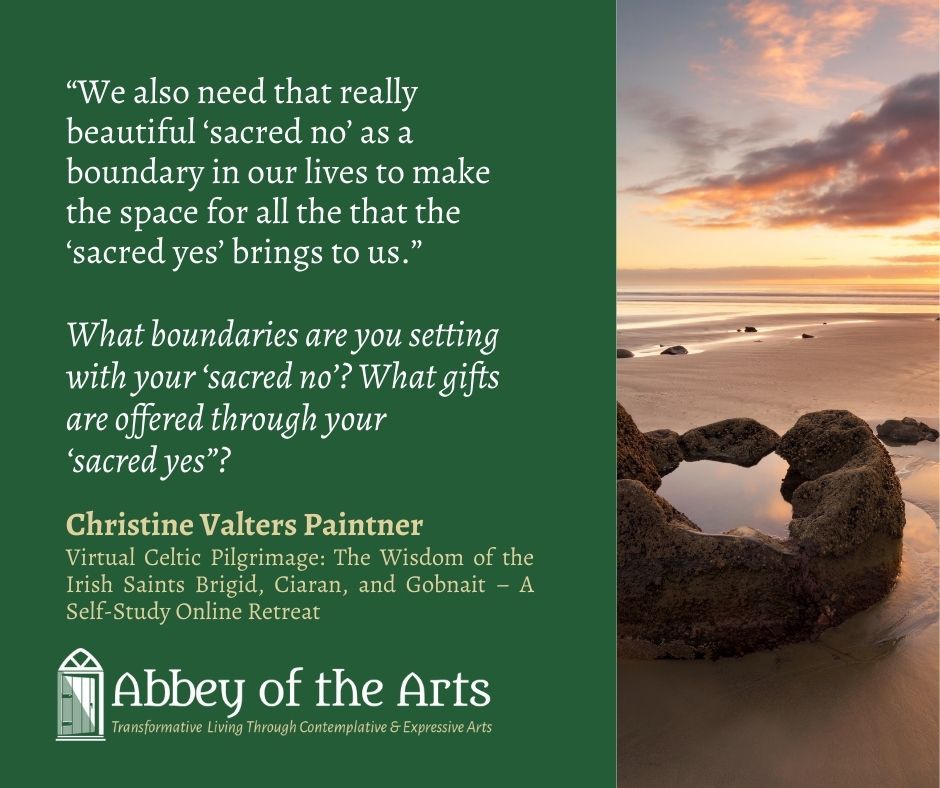
“We also need that really beautiful ‘sacred no’ as a boundary in our lives to make the space for all the that the ‘sacred yes’ brings to us.”
— Christine Valters Paintner, PhD, Virtual Celtic Pilgrimage: The Wisdom of the Irish Saints Brigid, Ciaran, and Gobnait – A Self-Study Online Retreat
What boundaries are you setting with your ‘sacred no’? What gifts are offered through your ‘sacred yes”?

