
Detachment is often understood as letting loose of what is attractive. But it sometimes also requires letting go of what is repulsive. You can indeed become attached to dark forces such as resentment and hatred. As long as you seek retaliation, you cling to your own past. Sometimes it seems as though you might lose yourself along with your revenge and hate—so you stand there with balled-up fists, closed to the other who wants to heal you. . . .
Praying means, above all, to be accepting of God who is always new, always different. For God is a deeply moved God, whose heart is greater than our own. The open acceptance of prayer in the face of an ever-new God makes us free. In prayer, we are constantly on our way, on a pilgrimage. On our way, we meet more and more people who show us something about the God whom we seek. We will never know for sure if we have reached God. But we do know that God will always be new and that there is no reason to fear.

“You cannot get through a single day without having an impact on the world around you. What you do makes a difference, and you have to decide what kind of difference you want to make.”—Jane Goodall, National Geographic, 1974
When we claim and constantly reclaim the truth of being the chosen ones, we soon discover within ourselves a deep desire to reveal to others their own chosenness. Instead of making us feel that we are better, more precious or valuable than others, our awareness of being chosen opens our eyes to the chosenness of others. That is the great joy of being chosen: the discovery that others are chosen as well. In the house of God there are many mansions. There is a place for everyone—a unique, special place. Once we deeply trust that we ourselves are precious in God’s eyes, we are able to recognize the preciousness of others and their unique place in God’s heart.

“Differences of race, nationality, or religion should not be used to deny any human being citizenship rights or privileges. Life is to be lived to its fullest so that death is just another chapter. Memories of our lives, of our works, and our deeds will continue in others.”—Rosa Parks
The greatest spiritual battle begins—and never ends—with the reclaiming of our chosenness. Long before any human being saw us, we are seen by God’s loving eyes. Long before anyone heard us cry or laugh, we are heard by our God who is all ears for us. Long before any person spoke to us in this world, we are spoken to by the voice of eternal love.

“Gandhi knew anger but controlled it. He knew fear but smiled at it and continued to oppose injustice. He knew hate but rejected it. He knew love and embraced it. He found nonviolence and nonviolent resistance and offered it to the world.”—Rajmohan Gandhi, Grandson of Mahatma Gandhi
Through compassion it is possible to recognize that the craving for love that people feel resides also in our own hearts, that the cruelty that the world knows all too well is also rooted in our own impulses. Through compassion we also sense our hope for forgiveness in our friends’ eyes and our hatred in their bitter mouths. When they kill, we know that we could have done it; when they give life, we know that we can do the same. For a compassionate man nothing human is alien; no joy and no sorrow, no way of living and no way of dying.
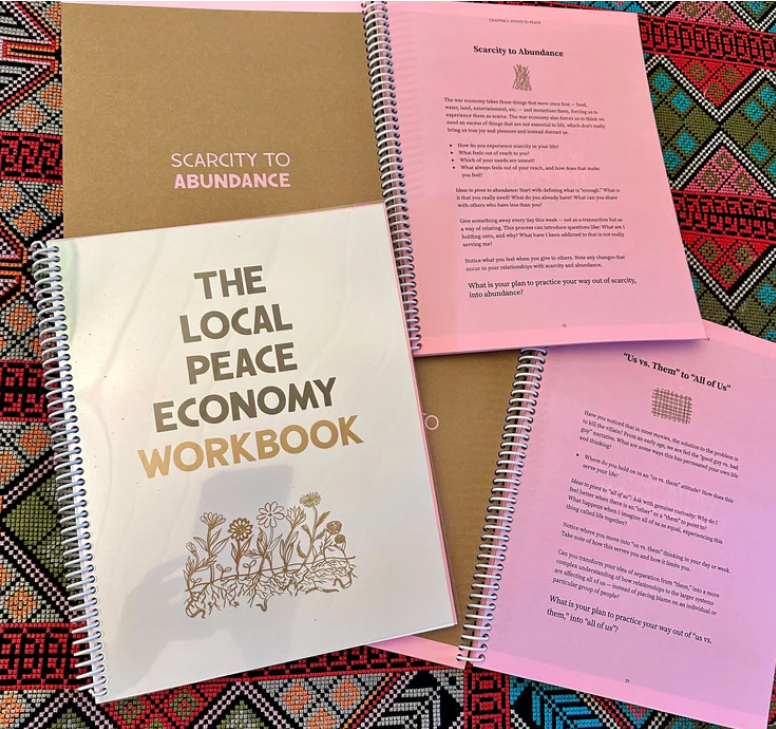
“The war economy—with its coercive system of racism, capitalism and neoliberalism—has each one of us entangled in a grip. We’ve been indoctrinated into war economy habits—but we can begin to practice our way out of the war economy into the local peace economy. This requires pivoting away from ways of being that serve the war economy—like alienation, apathy, scarcity, and control—into ways of being that cultivate conditions for peace—like connection, engagement, abundance, and rootedness. We call these the Pivots to Peace.”—The Peace Economy Workbook, CODEPINK
Compassion asks us to go where it hurts, to enter into the places of pain, to share in brokenness, fear, confusion, and anguish. Compassion challenges us to cry out with those in misery, to mourn with those who are lonely, to weep with those in tears. Compassion requires us to be weak with the weak, vulnerable with the vulnerable, and powerless with the powerless. Compassion means full immersion in the condition of being human.
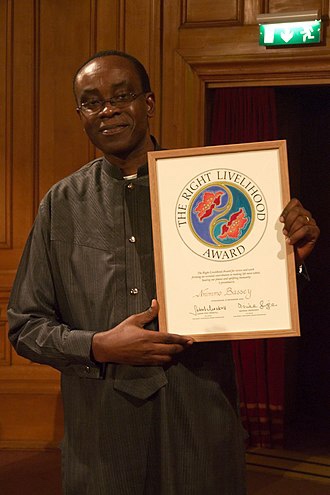
“The true environmental impact of war is impossible to quantify because it affects a staggering array of sectors and every aspect of human wellbeing. Wars kill people, extinguish biodiversity, and destroy the infrastructure that could otherwise provide safeguards in the face of extreme weather events. Warfare is an act of climate denial.”—Nigerian writer Nnimmo Bassey, Right Livelihood Award Laureate
 Pastor Michael Moore's Blog