
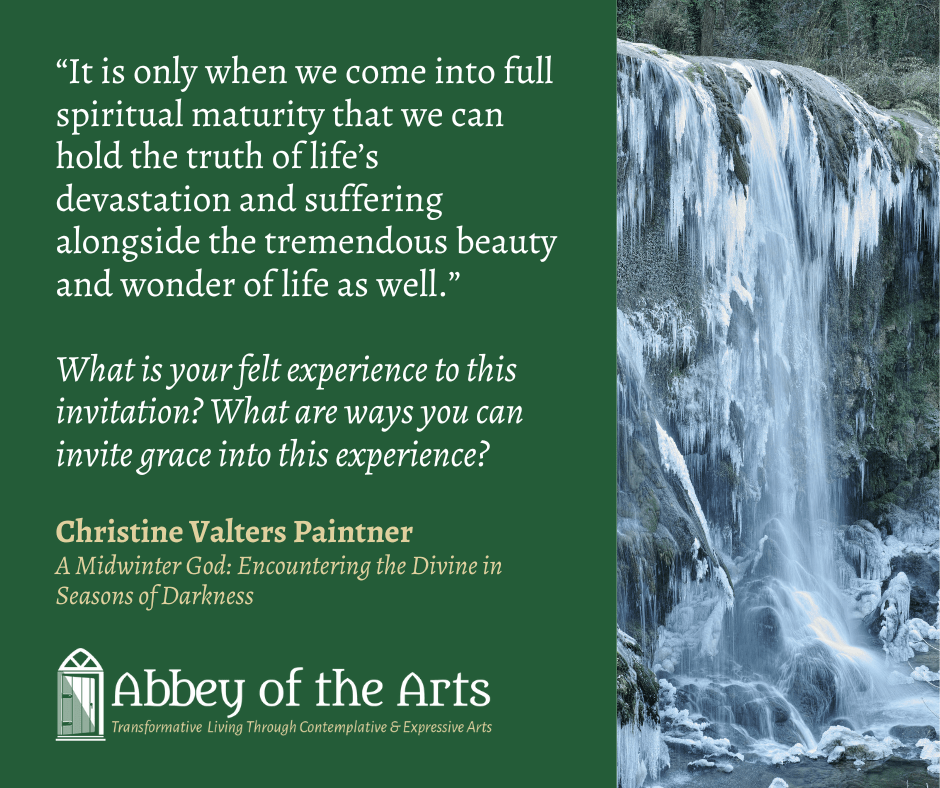
“It is only when we come into full spiritual maturity that we can hold the truth of life’s devastation and suffering alongside the tremendous beauty and wonder of life as well.”
—Christine Valters Paintner, PhD, A Midwinter God: Encountering the Divine in Seasons of Darkness
What is your felt experience to this invitation? What are ways you can invite grace into this experience?
To register for the self-study companion retreat to the book with additional resources and guidance, click here.
Verse of the day
Sow for yourselves righteousness; reap steadfast love; break up your fallow ground, for it is time to seek the Lord, that he may come and rain righteousness upon you.
– Hosea 10:12
Voice of the day
True abundance is never realized by the competition of insatiable desires for scarce goods. It is realized by emptying the small self into the larger reality of God’s superabundant life.
– William T. Cavanaugh, reprinted in Light for the Way, a new anthology from Sojourners.
Prayer of the day
Providing God, show us how to be mindful stewards by limiting our consumption and leaning into your abundance instead.
Verse of the day
And now I commend you to God and to the message of his grace, a message that is able to build you up and to give you the inheritance among all who are sanctified.
– Acts 20:32
Voice of the day
In the monastery, I was radicalized to believe again – that mercy abounds for the hurting, that faith is available to the unbelieving, and that justice is coming. I needed God to give me the eyes to see it and the hands to work for it.
– Hannah Keziah Agustin, reprinted in Light for the Way, a new anthology from Sojourners.
Prayer of the day
Faithful God, rekindle our belief in a better world, as well as our unmistakable place in beholding and building one.
Verse of the day
Then God said, “Let there be light,” and there was light. And God saw that the light was good, and God separated the light from the darkness.
– Genesis 1:3-4
Voice of the day
How can Christians celebrate? How can peace people celebrate when you are looking down the barrel of a neutron launcher? How can you women possibly be happy when you live in a church that treats you as if you are less than full human beings? Because the victory has been won. And hope has come. And light has been seen. And some people have shown it.
– Joan Chittister, reprinted in Light for the Way, a new anthology from Sojourners.
Prayer of the day
God our light, remind us that we are never far from you, however dark things may seem. Guide us in love to share your light with all who hunger for it.
Hospitality, therefore, means primarily the creation of a free space where the stranger can enter and become a friend instead of an enemy. Hospitality is not to change people, but to offer them space where change can take place. It is not to bring men and women over to our side, but to offer freedom not disturbed by dividing lines. It is not to lead our neighbour into a corner where there are no alternatives left, but to open a wide spectrum of options for choice and commitment. It is not an educated intimidation with good books, good stories and good works, but the liberation of fearful hearts so that words can find roots and bear ample fruit. It is not a method of making our God and our way into the criteria of happiness, but the opening of an opportunity to others to find their God and their way. The paradox of hospitality is that it wants to create emptiness, not a fearful emptiness, but a friendly emptiness where strangers can enter and discover themselves as created free; free to sing their own songs, speak their own languages, dance their own dances; free also to leave and follow their own vocations. Hospitality is not a subtle invitation to adopt the lifestyle of the host, but the gift of a chance for the guest to find his own. — Reaching Out: The Three Movements of the Spiritual Life
Our heart might desire to help others: to feed the hungry, visit the prisoners and offer a shelter to travelers; but meanwhile, we have surrounded ourselves with a wall of fear and hostile feelings, instinctively avoiding people and places where we might be reminded of our good intentions. — Reaching Out: The Three Movements of the Spiritual Life
If there is any concept worth restoring to its original depth and vocative potential, it is the concept of hospitality. It is one of the richest biblical terms that can deepen and broaden our insight in our relationships to our fellow human beings. Old and New Testament stories not only show how serious our obligation is to welcome the stranger in our home, but they also tell us that guests are carrying precious gifts with them, which they are eager to reveal to a receptive host. — From: Reaching Out: The Three Movements of the Spiritual Life
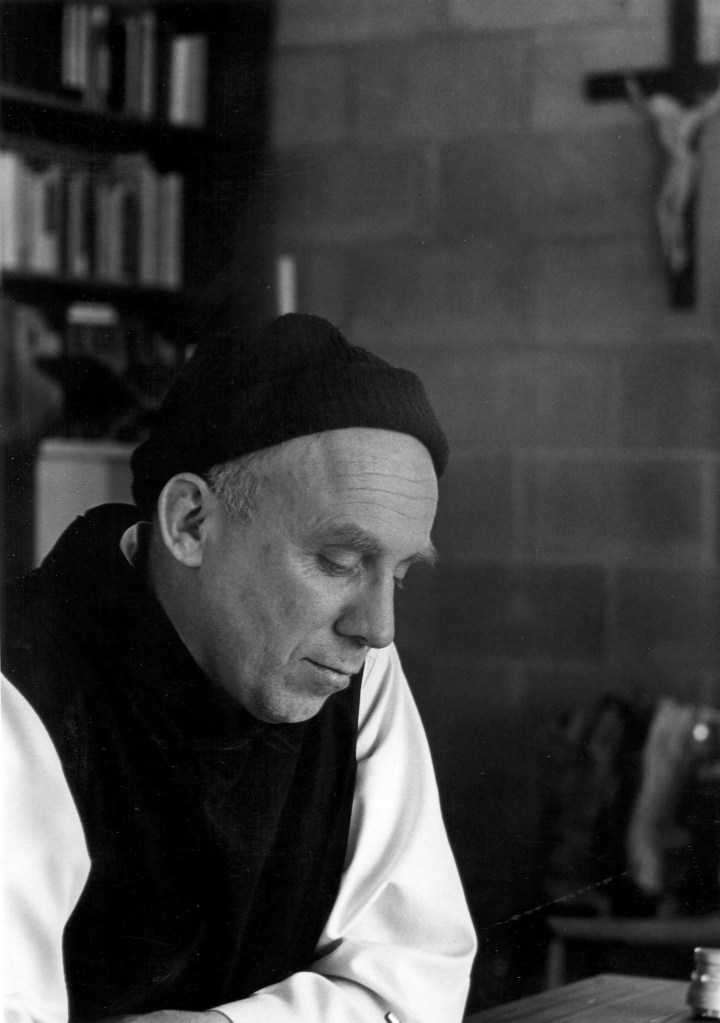
As I read the quote below from Thomas Merton’s book Seeds of Destruction, I noted how his thoughts from the 1960’s fit in with what is happening today in the world of mass media.
…in the moral climate of mass opinion, engineered by publicists, “truth” tends to mean a sensational revelation of some new iniquity on the part of the enemy. And the misfortune is that on both sides there is enough real iniquity around to make the concoction of sensational news items quite easy. Justice, in this climate, operates on a double standard: one for one’s own side and another for the enemy, so that what in him is criminal is, in us, simple “realism.” — Seeds of Destruction (location 1067, Kindle Edition)
We as a nation must wake up before the totality of the nightmare of George Orwell’s book 1984 becomes this nation’s reality. Do we really want this to be our reality?
Every record has been destroyed or falsified, every book rewritten, every picture has been repainted, every statue and street building has been renamed, every date has been altered. And the process is continuing day by day and minute by minute. History has stopped. Nothing exists except an endless present in which the Party is always right. — 1984
In the solitude of the heart we can truly listen to the pains of the world because there we can recognize them not as strange and unfamiliar pains, but as pains that are indeed our own. There we can see that what is most universal is most personal and that indeed nothing human is strange to us. There we can feel that the cruel reality of history is indeed the reality of the human heart, our own included, and that to protest asks, first of all, for a confession of our own participation in the human condition. There we can indeed respond. — Reaching Out: The Three Movements of the Spiritual Life
 Pastor Michael Moore's Blog