

I have become increasingly convinced that we need a worldwide paradigm shift in Christian consciousness for how we relate to God. Thomas Kuhn said that a paradigm shift becomes necessary when the previous paradigm becomes so full of holes and patchwork “fixes” that a complete overhaul—which once looked utterly threatening—now appears as a lifeline.
I believe we are at precisely such a moment when it comes to Christianity’s image of God.
A few weeks back a friend asked me, “When you speak of the need for a paradigm shift, what is the primary shift that you are talking about?” Admittedly, there was much I could have offered, but I shared that the most significant shift in our view of God is the move beyond the reward/punishment paradigm.
In my first years of preaching in the 1970s, I often told a Sufi-inspired story called “The Angel with the Torch and the Pail.” The story goes like this:
An angel was walking down the streets of the world carrying a torch in one hand and a pail of water in the other. A person asked the angel, “What are you doing with that torch and pail?”
The angel said, “With the torch I am burning down the mansions of heaven, and with the pail I am putting out the fires of hell. Then, and only then, will we see who truly loves God.”
Operating with love as the source, not fear of punishment or even promise of reward, is a radically different Christian paradigm. To do this takes an experience of love from the Infinite One. Then you are free to love others and even to truly love yourself. The most loving people I have met across the world in my lifetime of teaching and travelling all seemed to know that if love is the goal, it must be love for everybody.
Thank you for being a partner in shifting the paradigm towards infinite love. The Center for Action and Contemplation is primarily funded by people like you who give freely and joyfully to support it. Everything we offer the world is made possible through your support and participation. We are deeply grateful for each and every one of you.
Peace and Every Good,

Richard Rohr, OFM
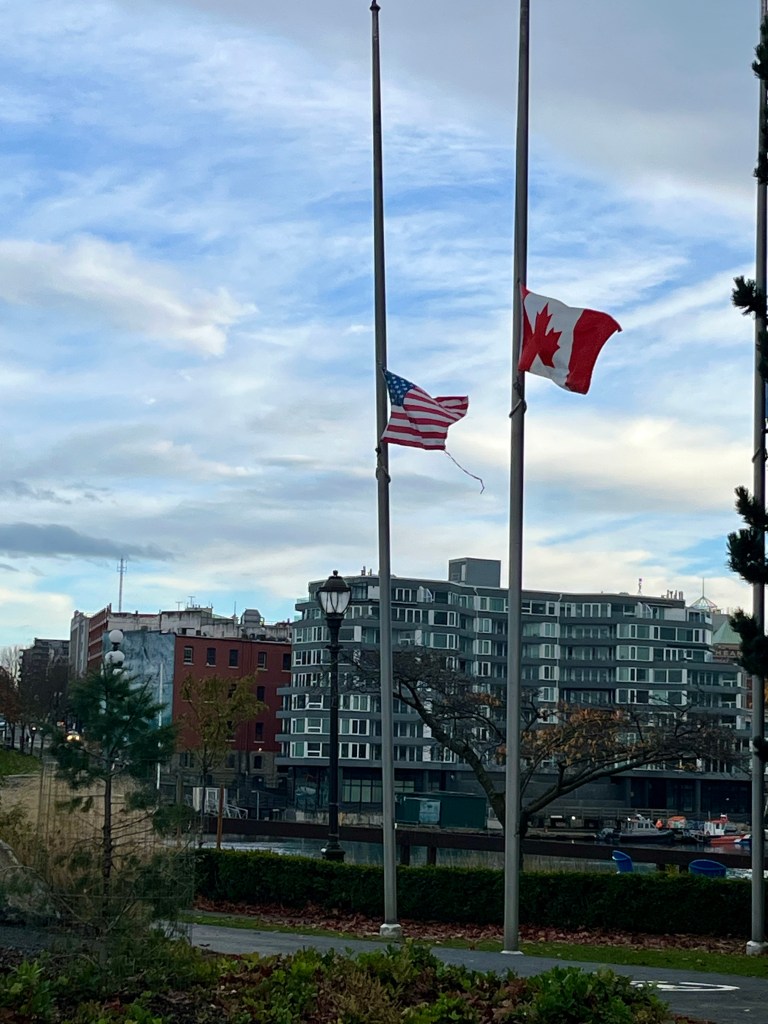
Today is Remembrance Day, an observance I was first introduced to during my first assignment in England. During that assignment and a subsequent assignment ten years later it was my honor to officiate at a number of Remembrance Sunday Services in local English churches. In England, November 11th was initially observed as Armistice Day in commemoration of the end of World War One. King George V requested two minutes of silence to be observed in acknowledgment of the war’s fatalities. When World War Two began, Armistice Day was not observed and in its place, a time of remembrance and worship was initiated on the second Sunday of November.
This year, Denise and I are in Victoria (the capital of British Columbia) and we attended a Remembrance Sunday service at Knox Presbyterian Church in Victoria. Before the service of the Lord’s day began, they marked the observance of Remembrance Sunday in worship. The following was the opening prayer of gathering:
God of justice and peace, we gather at this solemn time of year, aware of the costliness of human history. In the face of hostility between nations and neighbours, you have come to us in Jesus Christ, carrying no sword, calling us to serve as peace makers. In this time of worship, renew in us the hope that you will turn swords into ploughshares, and lead the world you love away from making war for pride or profit. By the power of your Spirit, renew your promise of peace with justice for all your peoples.
God of justice and mercy, we confess that the world around us is in a mess. Nations turn disputes over territory into acts of aggression. Old enemies stir up conflict with their rivals. Threats of violence keep us all on edge. We confess we have not learned from past
conflicts what leads to peace with justice among nations and neighbours. Forgive us and lead us in a better way. May it be so. Amen.
Given the state of the world and more specifically the United States of America, there is much to mourn. I found myself weeping during the service as I remembered not only the horrors of war, but the horrors that have been unleashed in the country and world. Hatred, Fear, Nativism, White Supremacy, Misogyny, christian nationalism, racism have been given free rein and are causing death and destruction at will.
While those whom we have met and talked to offer us profound sympathy over what we are experiencing, sadly they tell us that the same things are alive and well in Canada. This brings me back to Remembrance Sunday’s service and the gathering prayer. We confess that we have not learned from past conflicts what leads to peace and justice among nations and neighbours.
As we seek to live a life of nonviolence and peacemaking may God forgive us and lead us in a better way. May it be so. Amen.
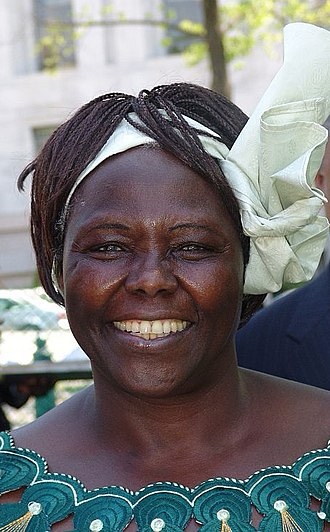
“In the course of history, there comes a time when humanity is called to shift to a new level of consciousness, to reach a higher moral ground. A time when we have to shed our fear and give hope to each other. That time is now.”—Wangari Maathai

As we approach Remembrance Sunday I am reposting this sonnet about the two minutes silence, which was first published in my book Sounding the Seasons…
Silence: a Sonnet for Remembrance Day
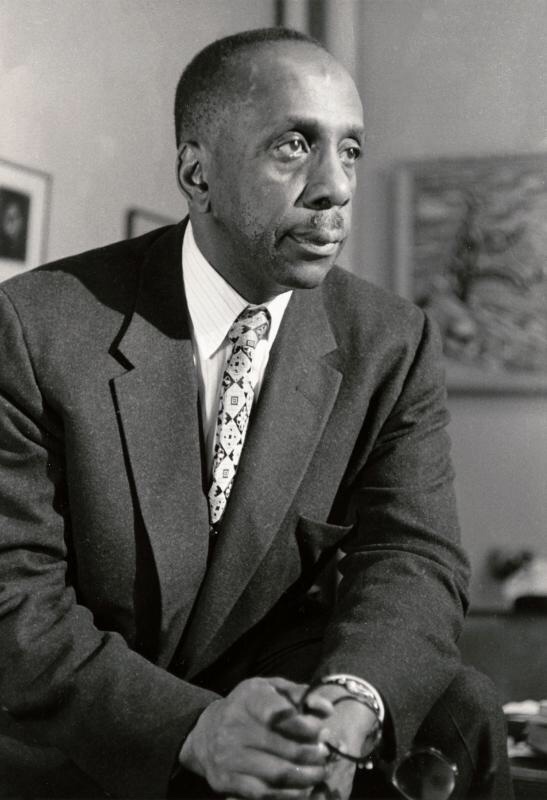
A brief quote from Thurman that speaks volumes:
It cannot be denied that too often the weight of the Christian movement has been on the side of the strong and the powerful and against the weak and oppressed—this, despite the gospel. — Jesus and the Disinherited, p. 31
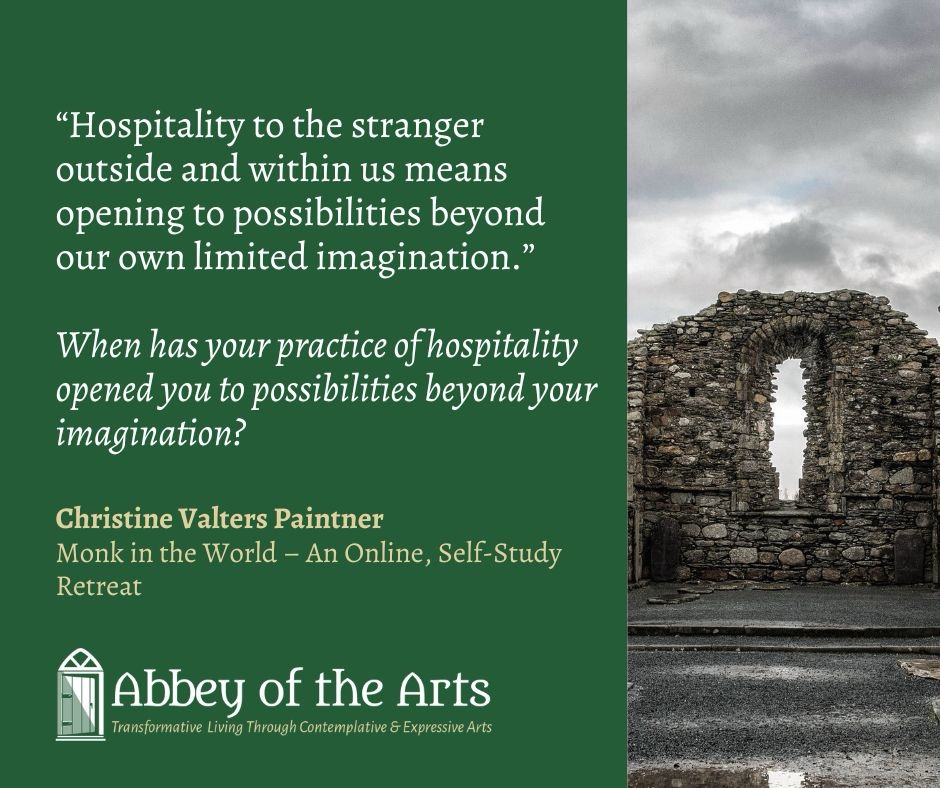
“Hospitality to the stranger outside and within us means opening to possibilities beyond our own limited imagination.”
— Christine Valters Paintner, PhD, Monk in the World – An Online, Self-Study Retreat
When has your practice of hospitality opened you to possibilities beyond your imagination?

I believe that, in light of the current religious and political landscape in the US, it is time for me to revisit an old friend and mentor of mine whose writings I was first introduced to in seminary in 1984. In class we had the opportunity to read Howard Thurman’s writings and listen to cassette tapes of his talks. This African American theologian and mystic has had a profound influence on my own ministry.
Many and varied are the interpretation dealing with the teachings and the life of Jesus of Nazareth. But few of these interpretations deal with what the teachings and the life of Jesus have to say to those who stand, at a moment in human history, with their backs against the wall. To those who need profound succor and strength to enable them to live in the present with dignity and creativity, Christianity often has been sterile and of little avail. The conventional Christian word is muffled, confused, and vague. Too often the price exacted by society for security and respectability is that the Christian movement in its formal expression must be on the side of the strong against the weak. This is a matter of tremendous significance, for it reveals to what extent a religion that was born of a people acquainted with persecution and suffering has become the cornerstone of a civilization and of nations whose very position in modern life has too often been secured by a ruthless use of power applied to weak and defenseless peoples. — Howard Thurman (Jesus and the Disinherited, p. 11-12)
As I watch the continued unfolding of christian nationalism, especially in light of the results of the 2024 Presidential election, I am at once horrified, angered, and deeply saddened. Notice that I didn’t say that I was surprised. I have seen this rise coming and even experienced it during my time in the military as a Chaplain. The idolatrous images of guns, flags, the cross, and the Bible being wrapped into a horrid package have been around for a long time. Watching christian nationalism being normalized in the media and in some parts of the “church” has not been easy.
The older (and hopefully wiser… 😉) I get, the more I have experienced my faith development as a deeper study and embodiment of the message of Jesus and the prophets and a broadening of my understanding of who Jesus is calling me to be. As long-time readers of my blog know, I call myself a Christ-follower to differentiate from the lower case “c” christians who have hijacked Jesus and wrapped him in the American flag and given him a golden assault rifle to carry. I am not alone. I have been hearing from and reading blogs of pastors who are struggling with their calling and specifically the churches they serve. They feel isolated and are afraid when they face those within the church who are hostile.
I’ve had those experiences myself and know how challenging they were for me. I was condemned by a young airman in a deployed location because I was teaching an Introduction to Islam course at the chapel. Besides confronting him with the fact that he was disrespecting a senior officer, I told him that I supported the commander’s thinking that we should learn about our host country and the majority religion of that country. After retiring from the chaplaincy and going back to the church, I’ve been condemned as a pastor (and they tried to shame me as a retired military chaplain) for seeking to remove the flag from the sanctuary or preaching the Gospel message that they find offensive. They didn’t stop me. While it isn’t easy these experiences make me thankful for the support and encouragement that I have also experienced in the midst of the fight from parishioners and friends.
I am well aware of my privilege as a cis-gender, white male minister who is retired from the military and the church. At the same time I am aware of those who are condemned or made to feel like second-class citizens by the church and society and my heart is breaking as they suffer. Where do I go from here? To be honest, I don’t know.
I am prayerfully trying to discern where God is calling me to continue ministry. I firmly believe that Jesus is walking with me as I stumble along on his path. I am also seeking opportunities to listen to and support those who are being oppressed and are under attack. In that journey, I will also continue to pray with another of my spiritual mentors, Thomas Merton. Like Thurman, Merton was an activist and a mentor to many in the peace movement. He wrote from the solitude of the monastery and later his hermitage on the grounds of the monastery. Thurman’s writings encouraged leaders like Dr. Martin Luther King, Jr., Congressman John Lewis, and so many others in the civil rights movement. Merton’s writings and retreats encouraged peace and anti-war activists like Fr. Daniel Berrigan and Dorothy Day to keep up the good fight against the forces of war and oppression. And so, I will leave you with Merton’s prayer.
My Lord God,
I have no idea where I am going.
I do not see the road ahead of me.
I cannot know for certain where it will end.
nor do I really know myself,
and the fact that I think I am following your will
does not mean that I am actually doing so.
But I believe that the desire to please you
does in fact please you.
And I hope I have that desire in all that I am doing.
I hope that I will never do anything apart from that desire.
And I know that if I do this you will lead me by the right road,
though I may know nothing about it.
Therefore will I trust you always though
I may seem to be lost and in the shadow of death.
I will not fear, for you are ever with me,
and you will never leave me to face my perils alone.
Source: Thoughts in Solitude, p. 79
Dear reader, will you pray with me and walk with me as I seek to be, in the words of St. Teresa of Avila, the hands and feet of Christ in this broken and hurting world?

“It is an unshakable faith with me that a cause suffers exactly to the extent that it is supported by violence.”—Mahatma Gandhi, Young India

“Now I know that true love consists in bearing all my neighbors’ defects, in not being surprised by mistakes but by being encouraged by the smallest of virtues.”—St. Thérèse of Lisieux

The presumed immortality of the empire has a horrid price attached… the death, even of great numbers, even of the innocent, must be rendered plausible, even normal. So the victims are variously demonized or stripped of their very dignity, their very faces. They are abstractions, “the enemy,” “the tyrant,” and so on. They are expendable. To the numbed citizenry, such lethal behavior on the part of authorities becomes a sort of wearisome abstraction… As we have seen it again and again in our lifetime, in our own country: Vietnam, Grenada, Panama, Nicaragua, Afghanistan, and Iraq. It is really astonishing, that from Babylon to Assyria to Egypt to Rome, the biblical story is the same. The empires rise, the empire does unutterable harm to the world, then the empire declines and falls. — Daniel Berrigan (Testimony: The Word Made Flesh, p. 176)
 Pastor Michael Moore's Blog