

“I am convinced that even violent temperaments can be channeled through nonviolent discipline, if they can act constructively and express through an effective channel their very legitimate anger.”—Martin Luther King Jr.

“All violence begins with the personal, with the I, and with a point of decision, a crossing of a line, where each of us chooses momentarily to view another living being as an It rather than a Thou. The ultimate purpose of each act of violence, each reduction of another person from a Thou to an It, is to control the other. . . . Our choices matter, even on what seems like a small scale. They have resonance in the universe. When we truly see another person or living being as a Thou, we cannot dominate or control them. We then must enter into a different kind of covenant, where power is shared.”—Pamela Cooper-White, The Cry of Tamar: Violence against Women and the Church’s Response
A powerful blog from my dear friend, colleague, and seminary classmate. Thank you, Shirley!
“God has brought down the powerful from their thrones and lifted up the lowly; God has filled the hungry with good things and sent the rich away …
A Moral Crisis – Faith Calls Us to Be Voices for the Voiceless

“We live in a world that is arming itself with nuclear weapons. At the same time, we have the sustainable development goals underfunded. We have underfunding of climate change adaptation and mitigation. If an alien ship orbiting the earth looked at this data, they would say, ‘These people are cuckoo; they’re nonsense.'”—President Carlos Alvarado Quesada on Disrupting Peace

“[Mary] teaches us how to root down deeply into her love and care, and then from this place of groundedness we increase our capacity to care for others and offer them hospitality.”
—Christine Valters Paintner, PhD, Birthing the Holy: Wisdom from Mary to Nurture Creativity and Renewal
What spiritual practices or guides help you root into love and care?
To register for the self-study companion retreat to the book with extra resources and guidance click here. Use code BH20 to take 20% off through December 31st.

“For us, warriors are not what you think of as warriors. The warrior is not someone who fights, because no one has the right to take another life. The warrior, for us, is one who sacrifices himself for the good of others. His task is to take care of the elderly, the defenseless, those who cannot provide for themselves, and above all, the children, the future of humanity!”
~ Sitting Bull Tatanka lyotake
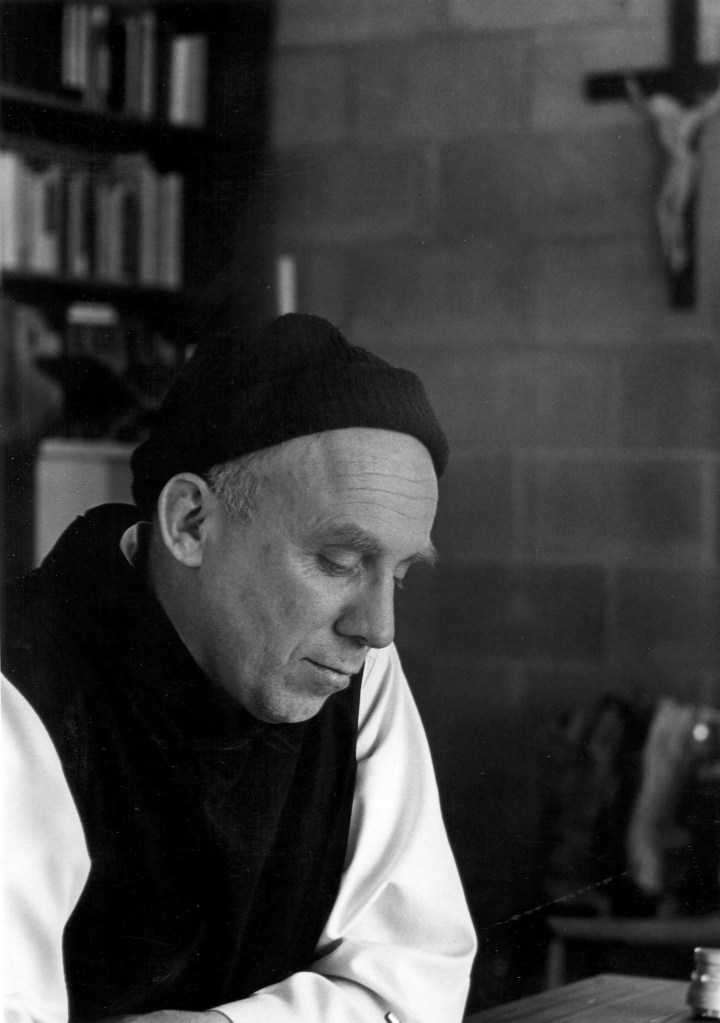
These words of Thomas Merton speak the hard truth to power.
Even where totalitarianism has not yet completely wiped out all liberty, men are still subject to the corrupting effect of materialism. The world has always been selfish: but the modern world has lost all ability to control its egoism. And yet, having acquired the power to satisfy its material needs and its desires for pleasures and comfort, it has discovered that these satisfactions are not enough. They do not bring peace, they do not bring happiness. They do not bring security either to the individual or to society. We live at the precise moment when the exorbitant optimism of the materialist world has plunged into spiritual ruin. We find ourselves living in a society of men who have discovered their own nonentity where they least expected to—in the midst of power and technological achievement. The result is an agony of ambivalence in which each man is forced to project upon his neighbors a burden of self-hatred which is too great to be tolerated by his own soul. — The Living Bread, p. 16
In a nation where politicians and oligarchs strip away rights and programs to assist the vulnerable this truth needs to be heard. As the Scrooges of this world (my apologies to old Ebenezer for using his name to describe the 1%) literally and figuratively kill the 99% in their quest for money and power, all their greed will amount to absolutely nothing. In the end, they will die just like everyone else and their money and so-called power will simply rot or be stolen.
We need to remind each other that the cup of sorrow is also the cup of joy, that precisely what causes us sadness can become the fertile ground for gladness. Indeed, we need to be angels for each other, to give each other strength and consolation. Because only when we fully realize that the cup of life is not only a cup of sorrow but also a cup of joy will we be able to drink it.
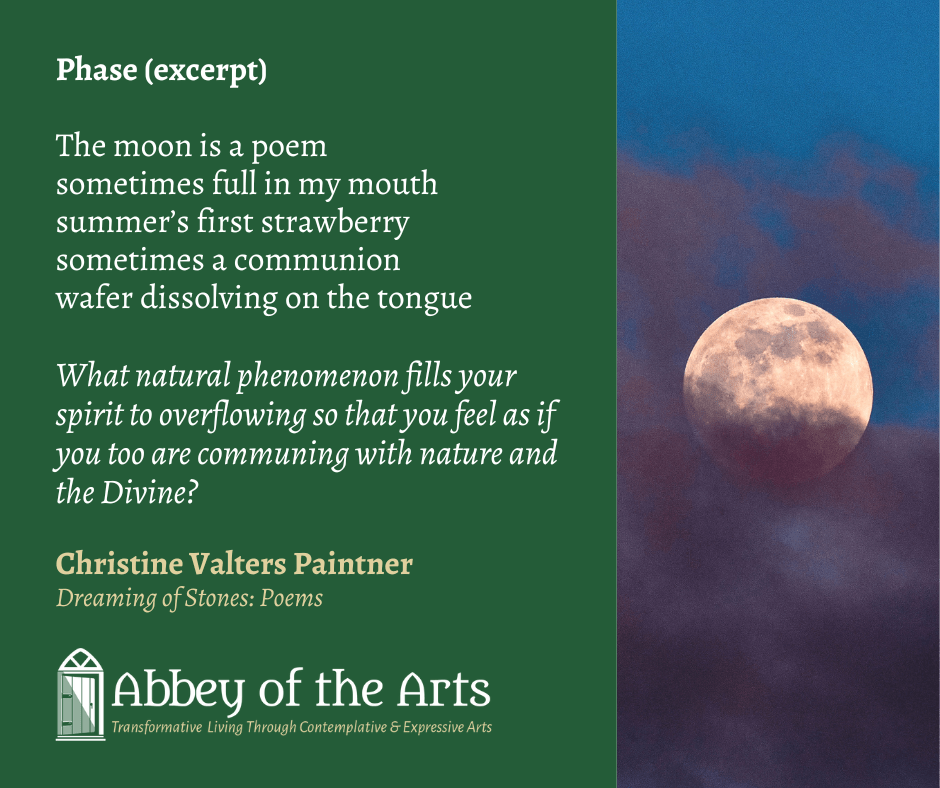
Phase (excerpt)
The moon is a poem
sometimes full in my mouth
summer’s first strawberry
sometimes a communion
wafer dissolving on the tongue
—Christine Valters Paintner, PhD, Dreaming of Stones: Poems
What natural phenomenon fills your spirit to overflowing so that you feel as if you too are communing with nature and the Divine?
Verse of the day
The mountains melt like wax before the Lord, before the Lord of all the earth.
– Psalm 97:5
Voice of the day
Fear is inevitable, I have to accept that, but I cannot allow it to paralyze me.
– Isabel Allende
Prayer of the day
When the mountain of fear seems insurmountable, give us the strength to keep going, because through you it can be overcome.
 Pastor Michael Moore's Blog