
Palm Sunday… Rocks & Stones…
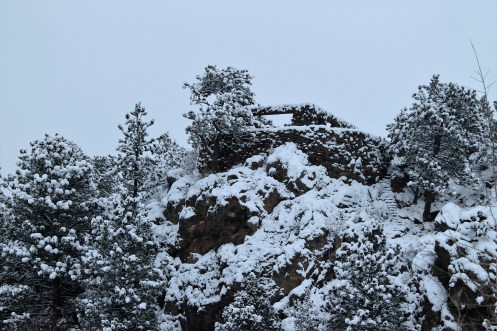
Yesterday I was in downtown Estes Park at the Police Station to do some paperwork as a part of the process of becoming a volunteer Chaplain for the Estes Park Police Department. From the parking lot out in front of the building, you can look up and see the ruins of this cabin overlooking the town. This description of the home comes from the following web site Birch Bungalow . “In 1904, Albert Birch engaged Carl Piltz, a blacksmith and a talented local stonemason, to build a small, one-story bungalow atop a rocky crag just north of the main street of the village of Estes Park. With a stunning view of Longs Peak and a dramatic location atop a perhaps 150 feet high rock outcropping, the stone bungalow with a massive fireplace, wrap-around porch on the south and west sides, and large window openings must have been a showcase jewel of turn-of-the-century rustic stone masonry craftsmanship. Unfortunately, on a bitterly cold night of December 21, 1907, the stone bungalow burnt because the floor joists under the fireplace had ignited. The massive stonework walls, fireplaces, porch and a staircase that partially descends the rock face remain. However, the ruins continue to be a cherished and romantic Estes Park skyline landmark since the unfortunate fire of 1907.”
Denise and I have been up there and I have taken some incredible pictures from the cabin and from Knoll Willows Nature Preserve which overlooks downtown Estes Park and the Stanley Hotel. One of the cool things about Estes Park is that the scenery changes daily depending upon the lighting and the seasons. When I came out from the Police Department, I knew that I had to capture the image. When I left the house I anticipated the opportunity and had my camera in the car. The bungalow is at once haunting and striking. From that perch you can see so much of our beloved town and the Rocky Mountains. It gives one pause to consider the beauty and the majesty of the Rockies and God’s creation. After the fire, Birch built a cabin at the base of the knoll along the creek. The view isn’t nearly as stunning, but not only can you see the Rockies from a different vantage point, you can watch Elk, Deer, Bobcats, Mountain Lions, and various wild residents of the community wander by.
Standing in the bungalow ruins, you overlook the main street of town (Elkhorn Avenue) where various seasonal parades go by. Thinking about that in the context of Palm Sunday, I wonder at the spectacle and sight that observers from the gates of Jerusalem would have observed when Jesus entered Jerusalem just before Passover.
Imagine if you will, that you are standing on the ramparts of Jerusalem near the Golden Gate (or the Gate of Mercy, Shaar Harashamim in Hebrew). This was the gate where the Jews believed that the Messiah would enter through as he brought redemption to the nation.
As an interesting side note, it is not only important to people of the Jewish faith (the Messiah would enter through it, bringing redemption to the nation), it was also important to the Muslims as the site of the future resurrection (the Dome of the Rock is on the Temple mount and the spot where Muhammad was said to ascend into heaven). The current gate was built in 6th/7th Century CE on the ruins of the gate from the Second Temple period. It’s history is fascinating — It was closed by the Muslims in 810 and reopened in 1102 by the Crusaders. It was walled up again by Saladin after he regained Jerusalem in 1187. Ottoman Sultan Suleiman the Magnificent rebuilt it together with the city walls, but walled it up in 1541, and it stayed that way until today.
I find it fascinating that there is such a tumultuous history to the gate down to this day. Anyway, back to the ramparts on the day when Jesus rode into Jerusalem. What the locals and the Romans were witnessing was an extraordinary event. It was an event that is often lost in our re-translations and re-creations of the Palm Sunday procession in our churches today. Today we watch (or fondly remember watching) the children process in with their palm branches raising while the choir sings “Hosanna, Loud Hosanna” or another Palm Sunday hymn. The pageantry remembers a portion of the event, but not the totality of it.
Jesus, by riding into Jerusalem on a donkey (or colt or foal of a donkey or both, depending upon the Gospel and translation) was both re-creating royal history. In 1 Kings 1:32-37 we read the following about Solomon: King David said, ‘Summon to me the priest Zadok, the prophet Nathan, and Benaiah son of Jehoiada.’ When they came before the king, the king said to them, ‘Take with you the servants of your lord, and have my son Solomon ride on my own mule, and bring him down to Gihon {a place near Jerusalem}. There let the priest Zadok and the prophet Nathan anoint him king over Israel; then blow the trumpet, and say, “Long live King Solomon!” You shall go up following him. Let him enter and sit on my throne; he shall be king in my place; for I have appointed him to be ruler over Israel and over Judah.’ Benaiah son of Jehoiada answered the king, ‘Amen! May the Lord, the God of my lord the king, so ordain. As the Lord has been with my lord the king, so may he be with Solomon, and make his throne greater than the throne of my lord King David.’ (NRSV)
The prophecy comes from Zechariah 9:9-12 — Rejoice greatly, O daughter Zion! Shout aloud, O daughter Jerusalem! Lo, your king comes to you; triumphant and victorious is he,
humble and riding on a donkey, on a colt, the foal of a donkey. He will cut off the chariot from Ephraim and the warhorse from Jerusalem; and the battle-bow shall be cut off, and he shall command peace to the nations; his dominion shall be from sea to sea, and from the River to the ends of the earth. As for you also, because of the blood of my covenant with you, I will set your prisoners free from the waterless pit. Return to your stronghold, O prisoners of hope; today I declare that I will restore to you double. (NRSV)
Now not only was Jesus very aware of the symbolic gesture he was making, so too were the followers who rejoiced at the gate. The symbolism of this entry near the beginning of their highest holy day (Passover) where they remembered God bringing them out of slavery and into freedom was incredible. And you can guarantee that this was not lost on the High Priest, the Pharisees, the Scribes, and the Jewish power elite! This was no ordinary joy ride on a donkey through a gate!
In effect, Jesus was thumbing his nose at the powers that be and making a radical and revolutionary statement (much like when he told the synagogue crowd that the prophecy of Isaiah which he had just read was fulfilled in their sight — see Luke 4:21 and Isaiah 61:1). Not only that, the very fact that he rode into Jerusalem like Solomon was a direct threat to the Romans. As a bonus, the fact that the crowd wildly proclaimed “Blessed is he who comes in the name of the Lord! Peace in heaven, and glory in the highest heaven!” (Luke 19:38),
It’s no wonder that the Pharisees said to him, “Teacher, order your disciples to stop.” (Luke 19:39) Jesus! Tell your people to SHUT UP! They are going to get us all killed! All Rome needs is a small excuse to turn the legions loose on us! Not only that, they are going to upset the balance of power that keeps us in “charge”!
So what did the Rebel Jesus do? “He answered, ‘I tell you, if these were silent, the stones would shout out.'” (Luke 19:40) Not only did Jesus refuse to tell the people to stop their shouts of Hosanna, he said if YOU silence them, God’s very creation, the rocks themselves would cry out the TRUTH! Yes, Palm Sunday was not simply a parade. In this moment, Jesus was himself shouting out to the powers that be, “God will not be silenced!”
As I have reflected upon this passage and the story of Palm Sunday, I can’t help but wonder how it applies to us today. The phrase (my paraphrase), “If you silence them, the very stones themselves would shout out God’s truth!” rings loudly in my head. And this statement reminds me of something from this world’s recent history.
The Lutheran and Reformed Churches share a common history in the Europe of the 1930’s. As Hitler rose to power he essentially perverted the church for his own use (the German Nationalist Church or Nazi Church which was his lap dog). A young seminary professor named Dietrich Bonhoeffer who was a visiting student and teaching fellow at Union Theological Seminary of New York felt compelled to return to Germany to confront this abomination head on. Despite advice from expat German theologians like Reinhold and H. Richard Niebuhr and Paul Tillich, he returned to Germany. He would teach in the seminary in Berlin and later in the underground seminary and be a voice speaking out against the nationalistic German Christian movement which was marrying the church to the state in an unholy alliance.
Bonhoeffer, Martin Niemoller, and Karl Barth (to name a few) were a part of a movement which would become the Confessing Church in Germany which was opposed to the German Christian movement. Out of this came a Confession of Faith called “The Theological Declaration of Barmen” (1934) It was a voice that essentially thumbed its nose at the oppressor (Nazi Germany) and her lapdog (German Christian Church) as it brought to the forefront the radical Gospel of Jesus Christ.
Does this story sound similar to what Jesus did on Palm Sunday? It should! Eventually, Bonhoeffer and many others would die at the hands of the Nazi machine with the willing complicity of their lapdog church just as Jesus died at the hands of the Roman machine with the willing complicity of the lapdog Priests, Pharisees, and Scribes.
A haunting quote that has come to my heart and mind more and more as I watch the disintegration of the political process and the warping of so-called American Christianity comes from Niemoller.
First they came for the Socialists, and I did not speak out—
Because I was not a Socialist.
Then they came for the Trade Unionists, and I did not speak out—
Because I was not a Trade Unionist.
Then they came for the Jews, and I did not speak out—
Because I was not a Jew.
Then they came for me—and there was no one left to speak for me.
Was Jesus speaking out on behalf of a people who’s faith was being hijacked by those who were in bed with a corrupt government and movement? Was he saying, “ENOUGH!” And just as importantly was he calling the people of faith to stand up against the perversion that was the “official religion of the empires lapdog”?
Frankly I believe that Jesus was calling all of creation (including the rocks themselves) to cry out against the injustice and oppression that was destroying God’s creation and God’s people! And I believe that he calls us to speak out today much in the way that he claimed the words of Isaiah for himself.
“…the Lord has anointed me; he has sent me to bring good news to the oppressed, to bind up the broken-hearted, to proclaim liberty to the captives, and release to the prisoners; to proclaim the year of the Lord’s favour, and the day of vengeance of our God; to comfort all who mourn; to provide for those who mourn in Zion—to give them a garland instead of ashes, the oil of gladness instead of mourning, the mantle of praise instead of a faint spirit.” (Isaiah 61:1b-3)
Dear reader, are you willing to raise your voice along with the Lord? Or are you content to be silent in the face of oppression and downright evil? Do you really want the stones to have to speak for you? Will you join with me in living out the vision of Micah? Are you willing to do justice (in word and in deed)? Are you willing to love mercy? Are you willing to walk humbly with God?
God have mercy on this nation and this world if we remain silent in the face of hatred, bigotry, and fearmongering. God help us if we remain silent in the face of the oppression of others… after all, in the words of Niehmoller, if we remain silent, who will speak for us when they finally come?
 Pastor Michael Moore's Blog